


Abstract
Objective. We examined the association between sleep and odds of developing knee pain, and whether this relationship varied by status of widespread pain (WSP).
Methods. At the 60-month visit of the Multicenter Osteoarthritis Study, sleep quality and restless sleep were each assessed by using a single item from 2 validated questionnaires. Each sleep measure was categorized into 3 levels, with poor/most restless sleep as the reference. WSP was defined as pain above and below the waist on both sides of the body and axially using a standard homunculus, based on the American College of Rheumatology criteria. Outcomes from 60–84 months included (1) knee pain worsening (KPW; defined as minimal clinically important difference in WOMAC pain), (2) prevalent, and (3) incident consistent frequent knee pain. We applied generalized estimating equations in multivariable logistic regression models.
Results. We studied 2329 participants (4658 knees; 67.9 yrs, body mass index 30.9]. We found that WSP modified the relationship between sleep quality and KPW (p = 0.002 for interaction). Among persons with WSP, OR (95% CI) for KPW was 0.53 (0.35–0.78) for those with very good sleep quality (p trend < 0.001); additionally, we found the strongest association of sleep quality in persons with > 8 painful joint sites (p trend < 0.01), but not in those with ≤ 2 painful joint sites. Similar results were observed using restless sleep, in the presence of WSP. The cross-sectional relationship between sleep and prevalence of consistent frequent knee pain was significant.
Conclusion. Better sleep was related to less KPW with coexisting widespread pain.
Knee osteoarthritis (OA) is the most common cause of chronic knee pain in middle-aged and older adults1,2. With OA as one of the 10 leading causes of function loss and disability worldwide3, pain in knee OA drives many patients to seek medical help and treatment. Hence, pain management remains a major goal of OA treatment. Because the prevalence of widespread pain (WSP) and poor sleep are high in persons with knee OA4,5,6, understanding these relationships altogether may provide new insights of pain management through sleep.
Sleep disturbance is more prevalent in patients with knee OA than those without OA4. About 50–80% of persons with knee pain or knee OA experience sleep problems5,6,7,8. Poor sleep quality, such as insomnia and short sleep duration, is related to increased systemic inflammatory cytokines9, such as C-reactive protein (CRP)10. Emerging evidence has also suggested the role of low-grade systemic inflammation and inflammatory synovium in the development and progression of pain symptoms and cartilage damage in OA10,11. Together, this evidence implies a plausible link between sleep and painful knee OA.
Historically, a reciprocal relationship has been noted between sleep and chronic pain, especially for those with WSP8,12,13. A previous review of longitudinal studies and clinical trials concluded that disordered sleep is more likely to precede pain than vice versa14. Additionally, greater numbers of painful joint sites predicted worsened pain outcomes even after knee or hip arthroplasty15, and WSP was associated with higher odds of knee pain worsening (KPW), even though the relationship was not statistically significant6. This evidence suggests that chronic multijoint pain could further affect worsened knee pain.
Although the tools or instruments vary regarding sleep measures, sleep has been suggested as a predictor of the development of WSP16,17,18. However, data on sleep in relation to knee pain per se are limited19,20, and often do not account for coexisting WSP in this relationship. In this study, we examined the association of 2 different sleep measures, sleep quality and restless sleep, with (1) KPW, and (2) consistent frequent knee pain, stratified by baseline WSP status (absence and presence). Given the literature cited above documenting an association of sleep with WSP, and poor sleep as one of the characteristic symptoms in chronic central pain21, we hypothesized that better sleep quality or less frequent restless sleep might improve knee pain to a greater degree among those with WSP than those without it. We further examined whether the number of painful joint sites affected the sleep and knee pain relationship.
MATERIALS AND METHODS
The Multicenter Osteoarthritis Study (MOST) is a prospective study, focusing on symptomatic knee OA in a community-based sample of adults with or at high risk of knee OA, based on the presence of knee symptoms, and history of knee injury or surgery, or being overweight. At the beginning in 2003, 3026 individuals (60.1% women) aged 50–79 years were enrolled from Birmingham, Alabama; and Iowa City, Iowa. Those who had rheumatoid arthritis or other forms of inflammatory arthritis were not eligible for the study. Those with fibromyalgia were neither identified nor excluded in MOST. The details of MOST have been described elsewhere22. After enrollment, participants were followed for up to 84 months. The institutional review boards granted approval for the MOST study [University of California, San Francisco (10–00500), Boston University (H-32956), University of Alabama at Birmingham (IRB-000329007), and University of Iowa (200003064 MOST-R)]. All participants provided written informed consent for study participation.
Sample of the study participants
We included 2329 participants (4658 knees) with valid values for sleep variables at 60 months (baseline of the study) regardless of their radiographic knee OA status in the analyses for KPW. For the outcome of prevalent consistent frequent knee pain, 2320 persons (4640 knees) were included for the cross-sectional analysis; after excluding those with prevalent consistent frequent knee pain at baseline, 1323 persons (2646 knees) were included in the longitudinal analyses for incident consistent frequent knee pain.
Baseline assessment for sleep quality
Self-reported sleep quality was assessed [a single item drawn from the Pittsburgh Sleep Quality Index (PSQI)]: “During the past 7 days, how would you rate your sleep quality overall?” on a 4-point Likert scale of “very good,” “fairly good,” “fairly bad,” and “very bad.” We also used frequency of restless sleep [a single item drawn from the Center for Epidemiologic Studies Depression Scale (CES-D)] in the past week as a second sleep measure: “During the past week, my sleep was restless” on a 4-point Likert scale or frequency: “Rarely or none of the time (less than 1 day),” “Some or little of the time (1–2 days),” “Occasionally or a moderate amount of the time (3–4 days),” and “Most or all of the time (5–7 days).” Because those who reported “very bad” sleep quality in the PSQI and those who reported restless sleep “most or all of the time” in the CES-D included < 10% of the sample, we combined the lowest 2 categories of sleep response as “poor sleep quality” for the item in the PSQI (combining “very bad” and “fairly bad”). For restless sleep in the CES-D, we combined the 2 most frequent restless categories to 1 group.
Measurements of knee pain
At each clinic visit, the participants were asked about knee pain twice using the following question: “During the past 30 days, have you had pain, aching, or stiffness in your right/left knee on most days?” first at a telephone screening and then again at the clinic visit on average 30 days later. A positive response to this question at both time-points defined presence of consistent frequent knee pain. We defined incident consistent frequent knee pain as occurring, when participants free of this condition at baseline developed new, consistent, frequent knee pain 2 years after baseline.
For the outcome of KPW, The Western Ontario and McMaster Universities Osteoarthritis Index (WOMAC) pain score ranges from 0 (no pain) to 20 (most pain) points. KPW was calculated based on the difference of knee-specific WOMAC pain score surveyed at the baseline and the 2-year followup visits. Based on the published estimates for the minimal clinically important difference in WOMAC23, worsened knee pain was defined as an increase in WOMAC pain score of ≥ 14%, or if WOMAC knee pain score of 0 at baseline increased by ≥ 2 at followup.
Other covariates
At the 60-month visit, the following information was collected: demographics, medication use, and lifestyle factors including tobacco use (pack-yrs), and general health assessments including fatigue [range from 0 (least fatigue) to 10 (most fatigue)], depression indicator by CES-D (cutoff score is 16 to define low and high depression)22, and the Charlson Comorbidity Index (CCI; range 0–9). Body weight (in kg) and standing height (in m) were measured by clinic staff. All subjects obtained a fixed flexion posterior-anterior radiograph, which was read centrally for Kellgren-Lawrence (KL) grade. A KL grade ≥ 2 was defined as radiographic knee OA. Using a standard homunculus that included circles over the joint regions of the shoulders, elbows, wrists, hands, hips, knees, ankles, feet, neck, and lower back, subjects identified body sites with pain on most of the past 30 days. WSP was defined according to the American College of Rheumatology criteria, based upon pain being present above the waist, below the waist, on both sides of the body, and in the axial region24. Also, the number of painful joint sites (including knee joints) was counted and ranged from 0 to 21. We further examined whether the association between sleep quality or restless sleep and knee pain differed by the number of painful joint sites according to the status of WSP.
Statistical analysis
We first assessed whether WSP modified the association between sleep quality or restless sleep and knee pain, by including a cross-product term for each sleep variable and WSP status (absence or presence) in a separate regression model. Because this analysis only suggested the association between sleep and worsening knee pain differed by WSP status (p for interaction < 0.01) for both sleep measures, no stratification was done for the analyses with frequent consistent knee pain (cross-sectional analysis for prevalence and longitudinal analysis for incidence). For KPW, we conducted longitudinal analysis to assess the relationships with KPW 2 years after baseline. Further, we prespecified additional analysis to be conducted if there was a significant association noted between a sleep measure and a knee pain outcome, stratified by the median number of painful joint sites in those with and without WSP.
In all analyses, we estimated the OR and its 95% CI using poor sleep quality or restless sleep at least 3–4 days in the past week as the referent group. For sleep quality, we compared very good and fairly good sleep quality as 2 separate categories. A similar approach was taken for restless sleep in the CES-D. We used logistic regression with generalized estimating equations to account for the correlations between 2 knees within an individual to estimate OR. We adjusted for the following potential confounders: age (yrs), sex (men vs women), race (white vs non-white), study site, body mass index (BMI; kg/m2), education level (college vs below college), tobacco smoking (pack-yrs), feeling of fatigue in the past 7 days (Likert scale of 0–10), CCI (range 0–9), high (CES-D score ≥ 16) versus low (CES-D < 16) number of depressive symptoms (the cutoff was defined previously25), and prescription use of nonsteroidal antiinflammatory drugs (NSAID; yes, no). We used CES-D as a dichotomous variable because of collinearity between restless sleep (single item included in the CES-D) and the full range score (0–50) in the CES-D variable.
Because not all participants had the same assessment for physical activity, we conducted sensitivity analysis among those whose step counts were assessed by accelerometry (76% of the analytic sample). The rest of the subjects either had no assessment for physical activity (19%) or were assessed using the Physical Activity Scale for the Elderly (5%).
All statistical analysis was conducted using SAS version 9.3 (SAS Institute Inc.). A 2-sided p value < 0.05 was considered statistically significant.
RESULTS
We included 2329 participants (4658 knees), of whom 60.5% were female and 84.3% were white. The mean age was 67.9 (SD 7.8) years and mean BMI was 30.9 (SD 6.1) kg/m2. There were 414 persons (18%) who reported poor sleep quality and 526 (23%) who experienced restless sleep at least 3–4 days in the past week. The correlation between these 2 single items from validated questionnaires for sleep measures is moderate to high (r = 0.69, p < 0.001).
The baseline characteristics across 3 categories of sleep quality in the past week are described in Table 1. Persons who reported better sleep quality tended to have less fatigue, less frequent use of prescription NSAID, less severe knee pain reflected by a lower WOMAC score at baseline, and less pain in other body sites, reflected by a lower proportion of having WSP at baseline. Similarly, those with better sleep quality had a lower CCI and were less likely to have high depressive symptoms.
Baseline characteristics of participants (n = 2329) according to sleep quality, a single item in the Pittsburgh Sleep Quality Index (PSQI) in the past 7 days.
The multivariable-adjusted OR (95% CI) for the associations between sleep quality and knee pain outcomes are presented in Table 2. We found a significant inverse relationship between sleep quality and consistent frequent knee pain cross-sectionally but not longitudinally. For KPW, the status of WSP (absence or presence) modified the relationship of KPW with sleep quality (p for interaction = 0.002); this relationship was stronger when WSP was present (p trend < 0.01) than when it was absent (p trend < 0.04). Among those with WSP, compared with those with poor sleep quality, persons with very good sleep quality had 47% lower odds (OR 0.53, 95% CI 0.35–0.78) of developing worsened knee pain, and those with fairly good sleep quality had 28% lower odds (OR 0.72, 95% CI 0.54–0.96).
OR (95% CI) for the association of sleep quality, a single item from the Pittsburgh Sleep Quality Index (PSQI) with knee pain outcomes stratified by baseline widespread pain status.
We examined the relationship of restless sleep with each knee pain outcome using the same approach (Table 3). Similar to the results for sleep quality, there was an inverse association between restless sleep and the prevalence of consistent frequent knee pain but not with the incidence. WSP status modified the relationship between restless sleep and KPW (p for interaction < 0.003). Compared to those with the most frequent restless sleep, persons who reported less frequent restless sleep (1–2 days/week or < 1 day/week) had lower odds of developing KPW when WSP was present (p trend = 0.05), but this protective association was not observed when WSP was absent.
OR (95% CI) for the association of restless sleep (a single item) using the Center for Epidemiologic Studies Depression Scale (CES-D) with knee pain outcomes stratified by baseline widespread pain status in the Multicenter Osteoarthritis Study.
We further examined whether the number of painful joint sites within each stratum of WSP influenced the association between sleep and KPW. The median for painful joint sites was 8 for those with WSP and 2 for those without WSP. We found that the strength of the relationship between sleep quality and KPW was greater among those with more painful joint sites in the presence of WSP (p trend < 0.01), while none of the results reached statistical significance in the absence of WSP (Figure 1). In a similar analysis for restless sleep, we found corroborative results, although no significant association was found. These stratified results by number of painful joint sites are presented in Supplementary Table 1 (available from the authors on request).
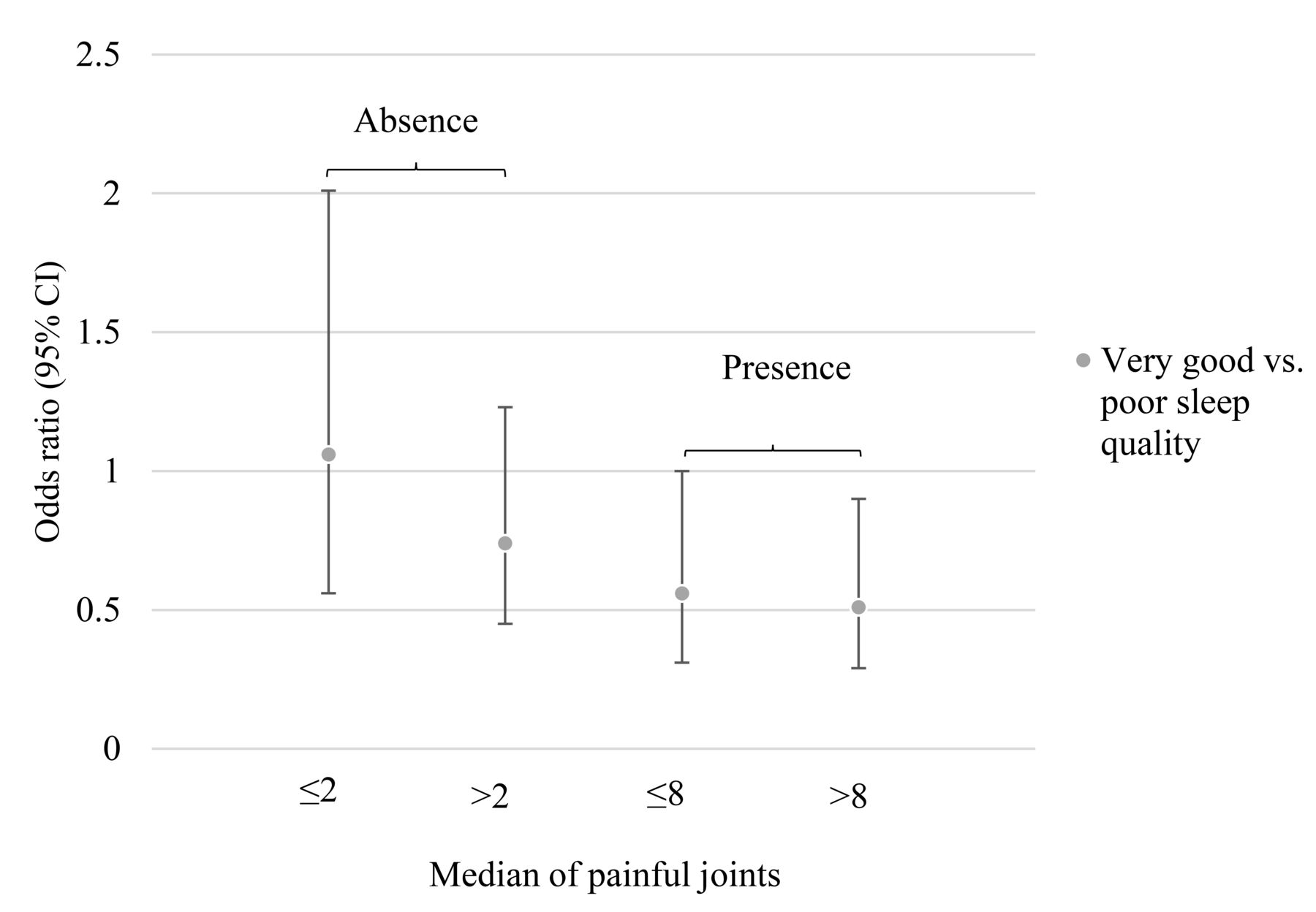
OR (95% CI) of knee pain worsening in those with very good sleep quality compared with those with poor sleep quality (a single item assessed by the Pittsburgh Sleep Quality Index), stratified by the median number of painful joint sites by widespread pain status (absence or presence).
In this study sample, 55.3% of knees had prevalent radiographic knee OA, whose distribution was similar among all categories of sleep quality (p = 0.11). Further adjusting for baseline radiographic knee OA did not change the results. In sensitivity analysis among those whose physical activity was assessed by accelerometry (76% of the analytic sample), further adjustment for steps per day in the models produced similar results. For example, compared with those who had poor sleep quality, those who reported a very good sleep quality had 44% lower odds of developing KPW (OR 0.66, 95% CI 0.42–1.03) when WSP was present (p for trend < 0.01). When WSP was absent, although the inverse relationship between sleep quality and KPW suggested a significant trend (p = 0.046), none of the results reached statistical significance. Similarly, compared with those with restless sleep > 3–4 days/week, the OR was 0.73 (95% CI 0.48–1.02) among those who experienced < 1 day/week restless sleep (p for trend = 0.06), and no relationship was found in the absence of WSP (p for trend = 0.75).
DISCUSSION
In a sample of individuals with or at high risk of knee OA, we found that better sleep quality (use of single item from the PSQI) was associated with lower odds of developing KPW over 2 years, especially in those with WSP. The greater the number of painful sites present, the more likely knee pain was related to sleep quality. Using a single question to assess restless sleep in the CES-D, we found consistent results for KPW among persons with coexisting WSP at baseline. Although sleep quality or restless sleep lowered the odds of prevalent consistent frequent knee pain, the relationship did not hold longitudinally 2 years later. Our findings highlight the importance of improving sleep as a potential strategy to relieve pain severity in knee OA, particularly in persons with WSP; our results also suggest that this effort is more likely to be successful in those with multiple painful joint sites.
Few studies have examined the temporal association of sleep to knee pain or other chronic pain in previous studies26,27,28. In 1 clinical trial, improved sleep continuance is suggested to reduce WOMAC knee pain in a 6-month trial29. Here, we additionally addressed coexisting musculoskeletal painful joint sites and WSP in our analyses. Our results raise the question as to whether, in those with knee pain, improvement in sleep quality or restless sleep might particularly benefit those with WSP. These research questions and findings have important clinical relevance, because WSP, knee pain, and poor sleep are highly prevalent in persons with knee OA.
In our study, among those with WSP, 32.5% of the subjects had worsening of knee pain 2 years later; this is in contrast with 20.0% of those without WSP. The larger effect estimate in those with WSP than those without it in our study may be explained by a phenomenon of chronic maladaptive pain17, whereby persons with WSP at baseline may have increased abnormal pain facilitation and deficits in pain inhibition, and therefore WSP may increase their risk of developing pain at other joint sites17. This phenomenon might explain, in part, our observed effects of sleep quality or restless sleep in reducing the odds of KPW in the presence of WSP.
Upon stratification of the status of WSP at baseline, we further divided persons based on the median of painful joint sites in each WSP stratum and found a stronger association between sleep quality and KPW among those with more painful joint sites. WSP is perceived as “centralized” pain and predominantly controlled by the central nervous system21,30,31. This concept has been further extended to pain in OA. Because centralized pain is closely related to disturbances of neurotransmitters in which sleep, for example, can play a role21, and because the number of painful body regions is significantly related to WOMAC pain15,32, these could explain the larger effect size of sleep quality in reducing knee pain severity among those with more painful joint sites (Figure 1).
We did not find significant associations of sleep quality with incidence of consistent frequent knee pain, while the significant cross-sectional associations were consistent with previous studies5,26. In 1 study, persistence of knee pain was associated with an increased risk of total knee replacement independent of WOMAC knee pain33, suggesting consistent frequent knee pain may reflect pain persistence. Hence, the dimensions of WOMAC knee pain severity and consistent frequent knee pain are likely different. Moreover, the sleep assessments used in this study were focused on sleep quality or restless sleep in the past 7 days, a time frame that is consistent with that over which WOMAC pain was assessed, but it is different from the assessment of consistent frequent knee pain (prior 30 days). This may explain the discrepancy of sleep in relation to WOMAC KPW versus consistent frequent knee pain longitudinally, but the cross-sectional relationship between sleep and consistent frequent knee pain can be bi-directional.
Biological mechanisms by which sleep may affect pain have been proposed34. Poor sleep quality or lack of sleep continuance is linked with increased systemic inflammation. Accompanying this finding, shorter sleep duration was associated with higher levels of CRP11,35,36, and CRP has been consistently associated with painful knee OA5. Further, because sleep disturbance may interact directly with central pain processing16,37, a growing body of evidence has suggested that environmental disruption of circadian rhythms may predispose to osteoarthritic-like damage to the joints, supported by the clock genes such as the brain and muscle Arnt-like protein 1 (Bmal1) found in the chondrocyte of articular cartilage38,39. This evidence may further support the link between poor or disrupted sleep and knee OA pain.
Strengths of our study include using multiple sleep measures and knee pain outcomes to assess the associations in a well-characterized prospective cohort while simultaneously considering the potential effect of body pain at other sites. We additionally performed longitudinal analyses that enable inferences about directionality of these associations that prior cross-sectional studies could not consider. A major limitation is that we used a single questionnaire item for sleep quality from the PSQI or restless sleep in the CES-D instead of an entire sleep quality questionnaire or objective polysomnography. This is because a full PSQI was not available, nor was duration of sleep measured in MOST. The correlation between the 2 sleep measures was moderately high (r = 0.69), suggesting that there are some overlapping characteristics between these 2 sleep constructs, which may partly explain similar results. Future studies with longterm comprehensive and objective sleep assessments are needed to verify these results to elucidate the effect of sleep on knee pain when other body pain comorbidities exist.
In individuals with or at risk of knee OA, those who had better sleep quality or less frequent restless sleep had lower odds of developing worsening knee pain over 2 years. This association was more apparent in those with WSP and a greater number of painful joint sites. However, neither sleep measure was associated with consistent frequent knee pain longitudinally. Because poor sleep and chronic painful joints commonly coexist in adults with knee OA, our study adds to other studies to support sleep improvement as a potential means of lessening knee pain severity, particularly in persons with WSP.
Footnotes
This study was supported by US National Institutes of Health grants: T32 AR7598 (Z. Dai), AR477785 and U01 AG18820 (D.T. Felson), U01 AG19069 (M. Nevitt), U01 AG18832 (J. Torner), U01 AG18947 (C.E. Lewis), and AR070892 (T. Neogi). Dr. Felson was also supported by the NIHR Manchester BRC. The funders had no role in study design, data collection and analysis, decision to publish, or preparation of the manuscript.
- Accepted for publication October 24, 2019.


