Main menu

  • Home
  • Content
    • First Release
    • Current
    • Archives
    • Collections
    • Audiovisual Rheum
    • 50th Volume Reprints
  • Resources
    • Guide for Authors
    • Submit Manuscript
    • Payment
    • Reviewers
    • Advertisers
    • Classified Ads
    • Reprints and Translations
    • Permissions
    • Meetings
    • FAQ
    • Policies
  • Subscribers
    • Subscription Information
    • Purchase Subscription
    • Your Account
    • Terms and Conditions
  • About Us
    • About Us
    • Editorial Board
    • Letter from the Editor
    • Duncan A. Gordon Award
    • Privacy/GDPR Policy
    • Accessibility
  • Contact Us
  • JRheum Supplements
  • Services

User menu

  • My Cart
  • Log In

Search

  • Advanced search
The Journal of Rheumatology
  • JRheum Supplements
  • Services
  • My Cart
  • Log In
The Journal of Rheumatology

Advanced Search

  • Home
  • Content
    • First Release
    • Current
    • Archives
    • Collections
    • Audiovisual Rheum
    • 50th Volume Reprints
  • Resources
    • Guide for Authors
    • Submit Manuscript
    • Payment
    • Reviewers
    • Advertisers
    • Classified Ads
    • Reprints and Translations
    • Permissions
    • Meetings
    • FAQ
    • Policies
  • Subscribers
    • Subscription Information
    • Purchase Subscription
    • Your Account
    • Terms and Conditions
  • About Us
    • About Us
    • Editorial Board
    • Letter from the Editor
    • Duncan A. Gordon Award
    • Privacy/GDPR Policy
    • Accessibility
  • Contact Us
  • Follow Jrheum on BlueSky
  • Follow jrheum on Twitter
  • Visit jrheum on Facebook
  • Follow jrheum on LinkedIn
  • Follow jrheum on YouTube
  • Follow jrheum on Instagram
  • Follow jrheum on RSS
LetterLetter

Polyserositis in a Patient with Active Systemic Lupus Erythematosus: A Case of Pseudo-pseudo Meigs Syndrome

EVANGELIA ZAMPELI, FOTINI N. SKOPOULI and HARALAMPOS M. MOUTSOPOULOS
The Journal of Rheumatology June 2018, 45 (6) 877-878; DOI: https://doi.org/10.3899/jrheum.171296
EVANGELIA ZAMPELI
Institute for Autoimmune Systemic and Neurological Disorders;
MD
  • Find this author on Google Scholar
  • Find this author on PubMed
  • Search for this author on this site
  • For correspondence: zampelieva{at}gmail.com
FOTINI N. SKOPOULI
Department of Internal Medicine and Clinical Immunology, Euroclinic Hospital;
MD, FRCP (London)
  • Find this author on Google Scholar
  • Find this author on PubMed
  • Search for this author on this site
HARALAMPOS M. MOUTSOPOULOS
Institute for Autoimmune Systemic and Neurological Disorders, and Academy of Athens, Athens, Greece.
MD, FACP, FRCP(hc), Master ACR
  • Find this author on Google Scholar
  • Find this author on PubMed
  • Search for this author on this site
  • Article
  • Figures & Data
  • Info & Metrics
  • References
  • PDF
PreviousNext
Loading

To the Editor:

A 40-year-old woman was diagnosed with systemic lupus erythematosus (SLE) 10 years ago, manifesting with edematous hands, Raynaud phenomenon, livedo reticularis, arthralgias/arthritis of hand joints, and lymphadenopathy, without renal involvement. Laboratory and serological findings included chronic disease anemia, leukopenia, and diffuse hypergammaglobulinemia; positive antinuclear, anti-Sm, anti-Ro (Ro52 and Ro60), and increased anti-dsDNA antibodies; and hypocomplementemia. For the last 2 years, she was in remission under methylprednisolone 4 mg/day, azathioprine 100 mg/day, and hydroxychloroquine 200 mg/day. Two months before presentation, feeling inundated by the chronicity of her disease and treatment, she discontinued all medication. Upon presentation, she was unwell and dyspneic, and had intense livedo of lower extremities, Raynaud phenomenon, edematous hands with arthritis, and a distended abdomen. Breathing sounds of the left lung base were reduced. There was no pericardial friction rub or pulsus paradoxus, and echocardiography revealed a nonhemodynamically relevant pericardial effusion. Chest and abdominal computed tomography showed, in addition to the pericardial effusion, a unilateral pleural effusion (Figure 1A) and massive ascites (Figure 1B). Remarkable laboratory tests included elevated C-reactive protein [CRP; 30 mg/l, normal value (nv) < 5 mg/l], diffuse hypergammaglobulinemia (gamma-globulins 34%), marked hypocomplementemia (C3 31 mg/dl, C4 < 3 mg/dl), and increased serum CA-125 (85 IU/ml, nv < 30 IU/l). Ascitic and pleural fluid analyses showed exudate effusions (ascites-protein/serum-protein = 0.6 and pleural effusion-protein/serum-protein = 0.6) and serum-ascites albumin gradient (1.1 g/dl). Multiple cultures and cytospin of both effusions were unrevealing. Considering the presence of ascites, pleural effusion, and elevated CA-125 levels, and after excluding underlying malignancy by imaging of the thorax and abdomen, and by cytological examination of the effusions, the diagnosis of pseudo-pseudo Meigs syndrome (PPMS) in the context of SLE exacerbation was made. The patient was given intravenous methylprednisolone pulses (1 g/d for 3 consecutive days), followed by mycophenolate mofetil (MMF; 3 g/d) and oral methylprednisolone (16 mg/d). Two months later, after initial temporary improvement, the patient (while still receiving the same treatment) presented again to our outpatient clinic with increasing dyspnea and abdominal distension. Complete clinical, laboratory, and imaging reevaluation again revealed exudative effusions, with laboratory and serological testing indicative of SLE exacerbation. Many autoantibodies were detected in the patient’s sera, including anti-Ro, anti-Sm, anti-UnRNP, antinucleosome, antihistones, and antiriboprotein-P. MMF was discontinued and the patient was given monthly intravenous cyclophosphamide (0.75 g/m2 body surface area), along with monthly methylprednisolone pulses (1 g). Four months later, with the patient still receiving the same treatment, no pericardial, pleural, or ascitic effusions were detectable. Our present study was approved by the Ethical/Scientific Committee of the Laikon Hospital (no. 12/20-4-2016), and the patient provided informed consent according to the Declaration of Helsinki.
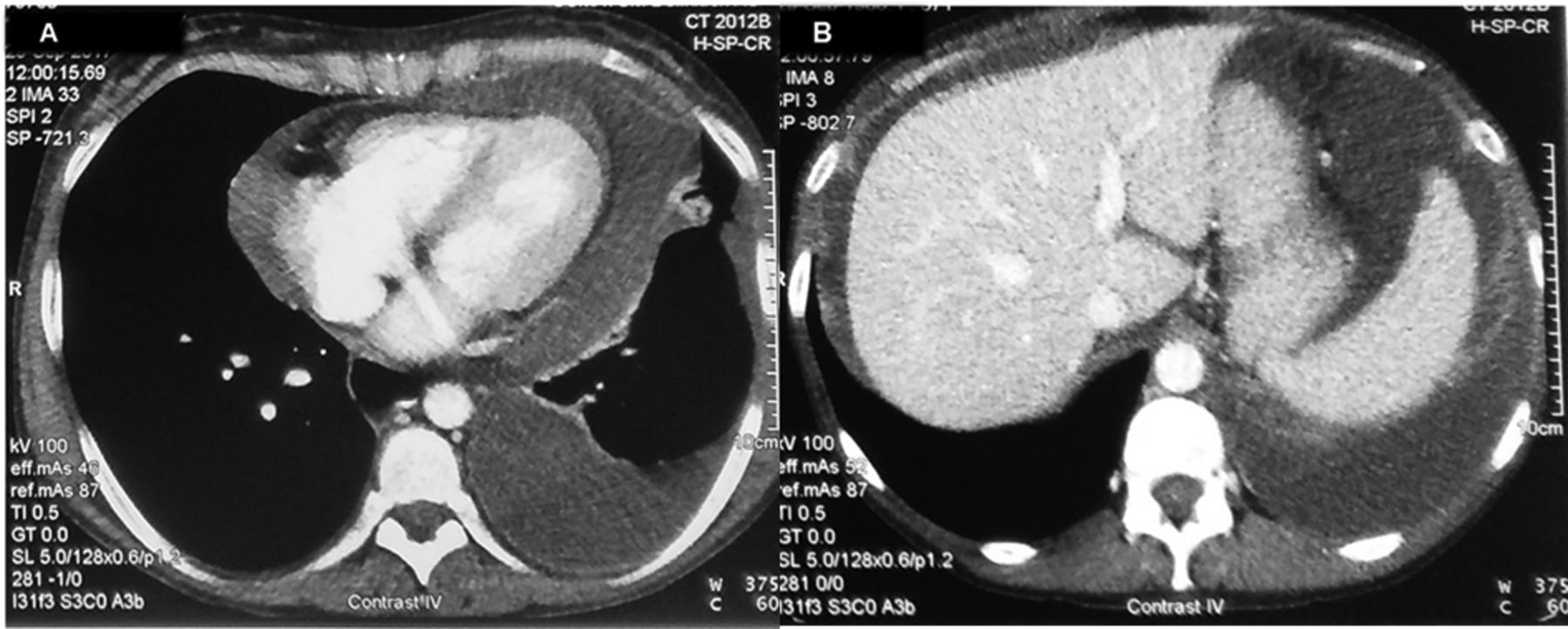
Chest and abdominal CT showed, in addition to the pericardial effusion, a unilateral pleural effusion (A) and massive ascites (B). CT: computed tomography.
  • Download figure
  • Open in new tab
  • Download powerpoint
Figure 1.

Chest and abdominal CT showed, in addition to the pericardial effusion, a unilateral pleural effusion (A) and massive ascites (B). CT: computed tomography.

Meigs syndrome is the presence of a benign ovarian tumor (fibroma or fibroma-like) in conjunction with pleural effusion and ascites1. Pseudo-Meigs syndrome is the coexistence of pleurisy and ascites secondary to nonfibroma ovarian or pelvic tumors2. What causes peritoneal and pleural effusions is still unclear, and contradictory data regarding the characteristics of effusions as transudates or exudates have been presented3. These syndromes are infrequent, yet are clinically important because although clinical manifestations suggest disseminated malignancy, symptoms subside after tumor excision, which is diagnostic for both syndromes.

PPMS is a rare clinical entity described in patients with SLE, characterized by pleurisy, ascites, and elevated CA-125 levels, similar to Meigs and pseudo-Meigs syndromes, but without association to any benign or malignant tumor4. There are few reports of PPMS in association to SLE (SLE-PPMS)5,6,7,8. All SLE-PPMS cases described refer to female patients of reproductive age, with hypocomplementemia, high anti-dsDNA titers, and exudative ascitic and pleural effusions with increased serum CA-125 as presenting manifestations of SLE. High CRP is reported only in SLE-PPMS cases with arthritis7,8.

The pathogenesis of effusion production in SLE-PPMS remains unknown. Type I interferon produces immune dysregulation in SLE, which in turn tilts T cell function toward Th cell phenotype, promoting B cell differentiation and release of the proinflammatory mediators interleukin 6 and tumor necrosis factors, contributing to tissue inflammation. CA-125 is an accepted tumor marker for ovarian cancer, yet serum concentrations can rise in various benign conditions. Peritoneal mesothelial cells express CA-125 constitutively, and synthesis is increased when mesothelial cells are activated by inflammatory cytokines9. Taking into account the aforementioned, we suggest that in flaring SLE patients with a large inflammatory load who present with PPMS, the excess of inflammatory cytokines results in increased vascular permeability and capillary leakage, which could be responsible for the production of pleural, pericardial, and ascitic effusions; the inflammatory load also results in the activation of peritoneal mesothelial cells to secrete CA-125.

We present this case for several reasons. First, SLE-PPMS is a rare clinical entity. Second, clinicians should be aware that increased CA-125 in patients with ascites and pleural and pericardial effusions needs careful interpretation and does not always indicate the presence of malignancy. Third, although it is known that SLE serositis does not cause significant effusions, in SLE-PPMS cases, massive polyserositis can be the initial manifestation either of the disease or of SLE exacerbation. Fourth, increased CRP in patients with SLE-PPMS is reported only in cases of patients with concomitant arthritis10. Finally, as in the case of our patient, aggressive combination immunosuppressive therapy might be required to assure a positive outcome in SLE-PPMS cases.

REFERENCES

  1. 1.↵
    1. Meigs JV
    . Fibroma of the ovary with ascites and hydrothorax; Meigs’ syndrome. Am J Obstet Gynecol 1954;67:962–85.
    OpenUrlPubMed
  2. 2.↵
    1. Meigs JV
    . Pelvic tumors other than fibromas of the ovary with ascites and hydrothorax. Obstet Gynecol 1954;3:471–86.
    OpenUrlPubMed
  3. 3.↵
    1. Krenke R,
    2. Maskey-Warzechowska M,
    3. Korczynski P,
    4. Zielinska-Krawczyk M,
    5. Klimiuk J,
    6. Chazan R,
    7. et al.
    Pleural effusion in Meigs’ syndrome-transudate or exudate?: systematic review of the literature. Medicine 2015;94:e2114.
    OpenUrl
  4. 4.↵
    1. Tjalma WA
    . Ascites, pleural effusion, and CA 125 elevation in an SLE patient, either a Tjalma syndrome or, due to the migrated Filshie clips, a pseudo-Meigs syndrome. Gynecol Oncol 2005;97:288–91.
    OpenUrlCrossRefPubMed
  5. 5.↵
    1. Schmitt R,
    2. Weichert W,
    3. Schneider W,
    4. Luft FC,
    5. Kettritz R
    . Pseudo-pseudo Meigs’ syndrome. Lancet 2005;366:1672.
    OpenUrlCrossRefPubMed
  6. 6.↵
    1. Ural UM,
    2. Kiliç A,
    3. Güngör T,
    4. Ozdal B,
    5. Mollamahmutoğlu L
    . Tjalma’s or pseudo-pseudo-Meigs’ syndrome: a case report. Clin Exp Dermatol 2008;33:363–4.
    OpenUrlCrossRefPubMed
  7. 7.↵
    1. Dalvi SR,
    2. Yildirim R,
    3. Santoriello D,
    4. Belmont HM
    . Pseudo-pseudo Meigs’ syndrome in a patient with systemic lupus erythematosus. Lupus 2012;21:1463–6.
    OpenUrlCrossRefPubMed
  8. 8.↵
    1. McVorran S,
    2. Song J,
    3. Pochineni V,
    4. Abrudescu-Opran A
    . Systemic lupus erythematosus presenting with massive ascites: a case of pseudo-pseudo Meigs syndrome. Case Rep Rheumatol 2016;2016:8701763.
    OpenUrl
  9. 9.↵
    1. Zeillemaker AM,
    2. Verbrugh HA,
    3. Hoynck van Papendrecht AA,
    4. Leguit P
    . CA 125 secretion by peritoneal mesothelial cells. J Clin Pathol 1994;47:263–5.
    OpenUrlAbstract/FREE Full Text
  10. 10.↵
    1. Moutsopoulos HM,
    2. Mavridis AK,
    3. Acritidis NC,
    4. Avgerinos PC
    . High C-reactive protein response in lupus polyarthritis. Clin Exp Rheumatol 1983;1:53–5.
    OpenUrlPubMed
PreviousNext
Back to top

In this issue

The Journal of Rheumatology
Vol. 45, Issue 6
1 Jun 2018
  • Table of Contents
  • Table of Contents (PDF)
  • Index by Author
  • Editorial Board (PDF)
Print
Download PDF
Article Alerts
Sign In to Email Alerts with your Email Address
Email Article

Thank you for your interest in spreading the word about The Journal of Rheumatology.

NOTE: We only request your email address so that the person you are recommending the page to knows that you wanted them to see it, and that it is not junk mail. We do not capture any email address.

Enter multiple addresses on separate lines or separate them with commas.
Polyserositis in a Patient with Active Systemic Lupus Erythematosus: A Case of Pseudo-pseudo Meigs Syndrome
(Your Name) has forwarded a page to you from The Journal of Rheumatology
(Your Name) thought you would like to see this page from the The Journal of Rheumatology web site.
CAPTCHA
This question is for testing whether or not you are a human visitor and to prevent automated spam submissions.
Citation Tools
Polyserositis in a Patient with Active Systemic Lupus Erythematosus: A Case of Pseudo-pseudo Meigs Syndrome
EVANGELIA ZAMPELI, FOTINI N. SKOPOULI, HARALAMPOS M. MOUTSOPOULOS
The Journal of Rheumatology Jun 2018, 45 (6) 877-878; DOI: 10.3899/jrheum.171296

Citation Manager Formats

  • BibTeX
  • Bookends
  • EasyBib
  • EndNote (tagged)
  • EndNote 8 (xml)
  • Medlars
  • Mendeley
  • Papers
  • RefWorks Tagged
  • Ref Manager
  • RIS
  • Zotero

 Request Permissions

Share
Polyserositis in a Patient with Active Systemic Lupus Erythematosus: A Case of Pseudo-pseudo Meigs Syndrome
EVANGELIA ZAMPELI, FOTINI N. SKOPOULI, HARALAMPOS M. MOUTSOPOULOS
The Journal of Rheumatology Jun 2018, 45 (6) 877-878; DOI: 10.3899/jrheum.171296
del.icio.us logo Twitter logo Facebook logo  logo Mendeley logo
  • Tweet Widget
  •  logo
Bookmark this article

Jump to section

  • Article
    • To the Editor:
    • REFERENCES
  • Figures & Data
  • Info & Metrics
  • References
  • PDF

Related Articles

Cited By...

More in this TOC Section

  • Hepatic Involvement in Systemic Juvenile Idiopathic Arthritis and Macrophage Activation Syndrome: Clinical and Therapeutic Insights From 2 Cases
  • Lung Ultrasound in Rheumatoid Arthritis–Associated Interstitial Lung Disease: Beyond a Promising Tool
  • O'Keeffe et al reply
Show more Letter

Similar Articles

Content

  • First Release
  • Current
  • Archives
  • Collections
  • Audiovisual Rheum
  • COVID-19 and Rheumatology

Resources

  • Guide for Authors
  • Submit Manuscript
  • Author Payment
  • Reviewers
  • Advertisers
  • Classified Ads
  • Reprints and Translations
  • Permissions
  • Meetings
  • FAQ
  • Policies

Subscribers

  • Subscription Information
  • Purchase Subscription
  • Your Account
  • Terms and Conditions

More

  • About Us
  • Contact Us
  • My Alerts
  • My Folders
  • Privacy/GDPR Policy
  • RSS Feeds
The Journal of Rheumatology
The content of this site is intended for health care professionals.
Copyright © 2025 by The Journal of Rheumatology Publishing Co. Ltd.
Print ISSN: 0315-162X; Online ISSN: 1499-2752
Powered by HighWire