Main menu

  • Home
  • Content
    • First Release
    • Current
    • Archives
    • Collections
    • Audiovisual Rheum
    • 50th Volume Reprints
  • Resources
    • Guide for Authors
    • Submit Manuscript
    • Payment
    • Reviewers
    • Advertisers
    • Classified Ads
    • Reprints and Translations
    • Permissions
    • Meetings
    • FAQ
    • Policies
  • Subscribers
    • Subscription Information
    • Purchase Subscription
    • Your Account
    • Terms and Conditions
  • About Us
    • About Us
    • Editorial Board
    • Letter from the Editor
    • Duncan A. Gordon Award
    • Privacy/GDPR Policy
    • Accessibility
  • Contact Us
  • JRheum Supplements
  • Services

User menu

  • My Cart
  • Log In

Search

  • Advanced search
The Journal of Rheumatology
  • JRheum Supplements
  • Services
  • My Cart
  • Log In
The Journal of Rheumatology

Advanced Search

  • Home
  • Content
    • First Release
    • Current
    • Archives
    • Collections
    • Audiovisual Rheum
    • 50th Volume Reprints
  • Resources
    • Guide for Authors
    • Submit Manuscript
    • Payment
    • Reviewers
    • Advertisers
    • Classified Ads
    • Reprints and Translations
    • Permissions
    • Meetings
    • FAQ
    • Policies
  • Subscribers
    • Subscription Information
    • Purchase Subscription
    • Your Account
    • Terms and Conditions
  • About Us
    • About Us
    • Editorial Board
    • Letter from the Editor
    • Duncan A. Gordon Award
    • Privacy/GDPR Policy
    • Accessibility
  • Contact Us
  • Follow Jrheum on BlueSky
  • Follow jrheum on Twitter
  • Visit jrheum on Facebook
  • Follow jrheum on LinkedIn
  • Follow jrheum on YouTube
  • Follow jrheum on Instagram
  • Follow jrheum on RSS
Research ArticleOther Arthritides

Outcome Measures Used in Arthroplasty Trials: Systematic Review of the 2008 and 2013 Literature

Bethan L. Richards, Peter D.H. Wall, Andrew P. Sprowson, Jasvinder A. Singh and Rachelle Buchbinder
The Journal of Rheumatology August 2017, 44 (8) 1277-1287; DOI: https://doi.org/10.3899/jrheum.161477
Bethan L. Richards
From the Institute of Rheumatology and Orthopaedics, Royal Prince Alfred Hospital; Sydney Medical School, University of Sydney, Sydney; Department of Epidemiology and Preventive Medicine, School of Public Health and Preventive Medicine, Monash University; Monash Department of Clinical Epidemiology, Cabrini Institute, Melbourne, Victoria, Australia; Birmingham Veterans Affairs Warwick Orthopaedics, University of Warwick, Coventry, UK; Medical Center and University of Alabama at Birmingham, Birmingham, Alabama; Mayo Clinic College of Medicine, Rochester, Minnesota, USA.
  • Find this author on Google Scholar
  • Find this author on PubMed
  • Search for this author on this site
Peter D.H. Wall
  • Find this author on Google Scholar
  • Find this author on PubMed
  • Search for this author on this site
Andrew P. Sprowson
  • Find this author on Google Scholar
  • Find this author on PubMed
  • Search for this author on this site
Jasvinder A. Singh
  • Find this author on Google Scholar
  • Find this author on PubMed
  • Search for this author on this site
  • For correspondence: Jasvinder.md{at}gmail.com jasvinder.singh{at}va.gov
Rachelle Buchbinder
  • Find this author on Google Scholar
  • Find this author on PubMed
  • Search for this author on this site
  • Article
  • Figures & Data
  • Info & Metrics
  • References
  • PDF
PreviousNext
Loading

Abstract

Objective. Previously published literature assessing the reporting of outcome measures used in joint replacement randomized controlled trials (RCT) has revealed disappointing results. It remains unknown whether international initiatives have led to any improvement in the quality of reporting and/or a reduction in the heterogeneity of outcome measures used. Our objective was to systematically assess and compare primary outcome measures and the risk of bias in joint replacement RCT published in 2008 and 2013.

Methods. We searched MEDLINE, EMBASE, and CENTRAL for RCT investigating adult patients undergoing joint replacement surgery. Two authors independently identified eligible trials, extracted data, and assessed risk of bias using the Cochrane tool.

Results. Seventy RCT (30 in 2008, 40 in 2013) met the eligibility criteria. There was no significant difference in the number of trials judged to be at low overall risk of bias (n = 6, 20%) in 2008 compared with 2013 [6 (15%); chi-square = 0.302, p = 0.75]. Significantly more trials published in 2008 did not specify a primary outcome measure (n = 25, 83%) compared with 18 trials (45%) in 2013 (chi-square = 10.6316, p = 0.001). When specified, there was significant heterogeneity in the measures used to assess primary outcomes.

Conclusion. While less than a quarter of trials published in both 2008 and 2013 were judged to be at low overall risk of bias, significantly more trials published in 2013 specified a primary outcome. Although this might represent a temporal trend toward improvement, the overall frequency of primary outcome reporting and the wide heterogeneity in primary outcomes reported remain suboptimal.

Key Indexing Terms:
  • ARTHROPLASTY TRIALS
  • SYSTEMATIC REVIEW
  • OUTCOME MEASURES

With an expanding and aging population, an escalating prevalence of obesity, and a rising need for both initial and joint revision surgery, the incidence and associated economic burden of joint replacement surgery has been projected to increase exponentially1. For many patients, joint replacement surgery is an effective management option to reduce pain, restore function, and improve quality of life. However, individuals who undergo joint replacement are also at risk for a variety of adverse events associated with both the anesthetic and the surgery. With expanding indications for joint replacement and the continuing evolution of surgical techniques and implants, many important research questions need to be answered. To address these issues there is an ongoing need for high-quality trials within this field of orthopedics.

Randomized controlled trials (RCT) are widely acknowledged to be the best type of trial design to evaluate the effectiveness and safety of healthcare interventions2,3,5. However, the RCT’s ability to answer important clinical questions will always be limited by its design and the outcome measures used. To draw meaningful conclusions from individual RCT, relevant, robust, and validated outcome measures are required. In addition, these outcomes should be prespecified and clearly reported as either primary or secondary. This enables readers to assess whether the RCT is adequately powered and avoids the perception of selective reporting bias.

In the field of joint replacement surgery, previously published literature assessing the reporting frequency, relevance, and homogeneity of outcome measures used has revealed disappointing results6. Specifically, primary outcomes were often not specified, and when they were, there was significant heterogeneity in the types of outcome measures used to assess the same endpoint. To address this on a large scale, several multinational collaborations and initiatives have been established. For example, following the poor findings in their systematic review, Riddle, et al proposed that consensus from an international group of experts involved in the care of these patients was needed7. In 2008, a working group within the Outcome Measures in Rheumatology (OMERACT) and the Osteoarthritis Research Society International was established with the aim of improving the reporting of relevant, evidence-based health outcome domains within joint replacement trials8. In addition, in 2008 the Enhancing the Quality and Transparency of Health Research Network was launched and in 2010 the Consolidated Standards of Reporting Trials (CONSORT) Statement (first published in 1996) was published to provide researchers with a checklist of 25 items to ensure accurate, complete, and transparent reporting of trial findings9.

It remains unknown whether these international initiatives have led to any improvement in the quality of joint replacement trial reporting and/or a reduction in the heterogeneity of outcome measures used. To investigate this question and inform the OMERACT 2014 Working Group meeting (which aimed to define an internationally agreed-upon core set of domains and outcome measures that should be reported in every joint replacement clinical trial)10, we performed a systematic review of outcomes that had been reported in joint replacement trials published in 2008 and 2013. This paper reports the risk of bias of included trials and assesses and compares their primary outcomes. A separate paper will report the extent to which all reported outcomes met the OMERACT criteria of truth, discrimination, and feasibility, and map the reported outcomes to the OMERACT Filter 2.011.

MATERIALS AND METHODS

Search strategy and criteria

This systematic review was performed in accordance with the PRISMA (Preferred Reporting Items for Systematic Reviews and Meta-Analyses) format12 and the protocol was prospectively registered with the International Prospective Register of Systematic Reviews (PROSPERO) Registration number: CRD42014009216. This study did not require ethics committee approval because it does not involve any humans or animals and is a systematic review of published articles in the medical literature.

All randomized or quasi-randomized (where allocation not strictly random) controlled trials investigating adult patients undergoing joint replacement surgery (defined as substitution of any joint surface with a prosthesis) were identified. Trials were included if the comparator was another type of joint implant, surgical placebo or sham, usual care, physical therapy, or other active treatment and at least 1 outcome had been reported. Studies were excluded if they evaluated spinal joint replacement surgery, had a primary intervention of interest that was not the insertion of a joint prosthesis (e.g., trials investigating preoperative education, perioperative analgesia, or postoperative care) or were not published as a full report in English.

An electronic literature search for articles published in 2008 and 2013 was performed in MEDLINE, EMBASE, and the Cochrane Central Register of Controlled Trials (CENTRAL) using a comprehensive search strategy (Table 1). We also performed a hand search of reference lists of relevant articles to identify additional relevant trials.

View this table:
  • View inline
  • View popup
Table 1.

Search Strategy for Medline and EMBASE.

Two authors (BLR and PDW) independently screened the titles and abstracts of all studies identified by the search strategy and then independently reviewed the full text of all potentially eligible studies to find studies that fulfilled the inclusion criteria. Any disagreement in study selection was resolved by consensus or by discussion with a third reviewer (RB).

The same 2 authors independently extracted data from the included studies using predetermined forms. Differences in data extraction were resolved by referring back to the original articles and establishing a consensus. A third reviewer (RB) was consulted to help resolve differences as necessary. The information extracted included study site, funding, enrollment date, size, design, population, interventions, and outcome measures (and whether they were prespecified). Each outcome was recorded as either primary or secondary. An outcome was recorded as primary if it was reported as a “primary outcome” in the manuscript or registered protocol or was used to calculate the sample size. More than 1 primary outcome could be recorded provided that these criteria were met.

Two authors (BLR and PDW) independently assessed risk of bias for all included studies using methods recommended by the Cochrane Collaboration13, which assess the following key criteria: random sequence generation, allocation concealment, blinding of participants, care provider and outcome assessor for each outcome measure, incomplete outcome data, selective outcome reporting, and other sources of bias. Other sources of bias that were considered included whether cointerventions and adherence to treatment (e.g., for analgesics and physical therapy programs) were assessed and reported to be equal between groups, and sources of funding. Each criterion was rated as low risk of bias, high risk of bias, or unclear risk (indicating either lack of information or uncertainty over the potential for bias). Information to inform the risk of bias rating was sourced from searching trial registries and the published papers.

An assessment of overall risk of bias was made in which low overall risk of bias indicated plausible bias unlikely to seriously alter the results (low risk of bias for all key domains), unclear overall risk of bias indicated plausible bias that raises some doubt about the results (unclear risk of bias for 1 or more key domains), and high overall risk of bias indicated plausible bias that seriously weakens confidence in the results (high risk of bias for 1 or more key domains)13. A third reviewer (RB) was consulted to resolve differences as necessary.

Data analysis

A descriptive analysis of the primary outcomes was performed that compared frequency and description of primary outcome measures by site of joint replacement and year. Comparison of 2008 and 2013 results for overall risk of bias and number of trials reporting primary outcomes was made using the Pearson chi-square tests. We also used the Pearson chi-square test to determine whether an association might exist between overall risk of bias and reporting of primary outcomes.

RESULTS

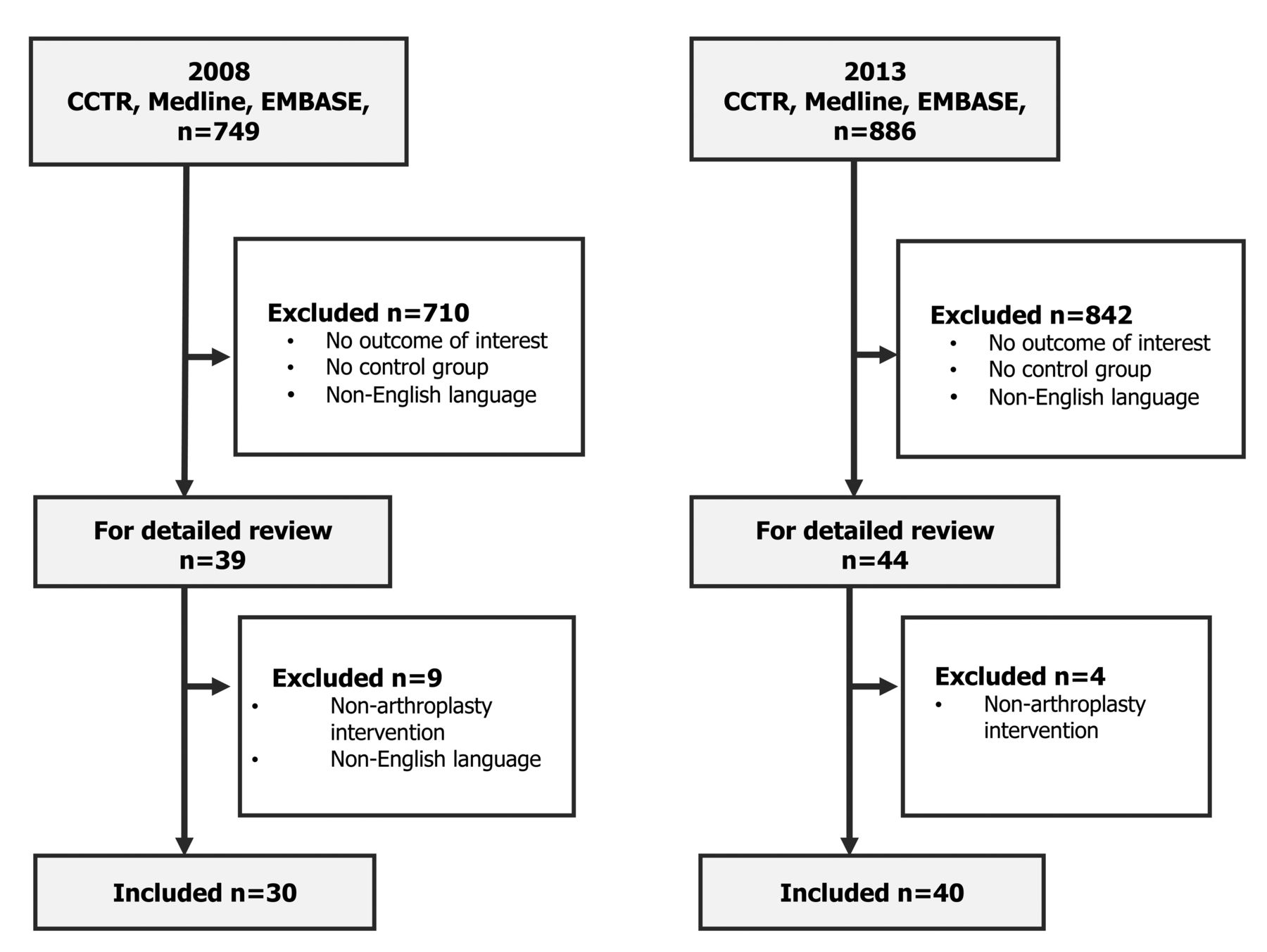
The search strategy identified 1635 studies. Of these, 70 RCT (30 with 2789 participants published in 2008 and 40 with 4253 participants published in 2013) met the eligibility criteria and were included in the review. A PRISMA flow diagram of the searches through to the final inclusion is shown in Figure 1. The summary characteristics of the included trials according to their year of publication are shown in Appendix 1.

Preferred Reporting Items for Systematic reviews and Meta-Analyses diagram showing selection of included trials.
  • Download figure
  • Open in new tab
  • Download powerpoint
Figure 1.

Preferred Reporting Items for Systematic reviews and Meta-Analyses diagram showing selection of included trials.

Study characteristics of trials published in 2008

Eighteen (60%) of the 30 trials published in 2008 were conducted in Europe14–23,24,25,26,39,40,41,42,43, 6 (20%) in the United States27,28,29,30,31,32, 2 (7%) each in Asia33,34 and Canada35,36, and 1 (3%) each in Australia37 and New Zealand38. Twenty trials (67%) were independently funded14,15,16,17,19,20,22,23,24,26,27,28,30,31,32,34,35,37,38,39, 9 (30%) had industry funding17,18,21,29,31,36,40,41,42, and for 1 trial, the source of funding was unclear25. The year of first recruitment ranged from 1994 to 2007 (median 2001). The most common joint evaluated was the knee (n = 19, 63%17,18,19,20,21,22,23,24,26,29,30,33,34,35,36,37,39,42,43), followed by the hip (n = 10, 33%14,15,16,27,28,31,32,38,40,41), and 1 trial (3%) evaluated the shoulder25. There were no trials evaluating joint replacement surgery of the elbow, wrist, hand, ankle, or foot. Fifteen (50%) trials evaluated 2 or more different prostheses or components 14,16,17,18,19,25,26,30,31,38–43, 13 (43%) evaluated the same prosthesis but used differing surgical techniques20,21,22,23,24,27,28,29,33,34,35,36,37, and 2 (1%) evaluated joint replacement versus other joint surgeries15,32.

Study characteristics of trials published in 2013

Twenty (50%) of the 40 trials published in 2013 were conducted in Europe44–53,54–63, 9 (23%) in Asia64,65,66,67,68,69,70,71,71a, 5 (13%) in the United States72,73,74,75,76, 4 (10%) in Canada77,78,79,80, and 1 (3%) each in Australia81 and the Middle East82. Twelve trials (30%) were industry funded45,52,54,55,56,59,62,63,70,73,77,80, 15 (38%) had independent funding44,46,48,50,51,53,57,60,64,65,69,72,78,81,82, and in 13 trials (33%) the source of funding was not specified47,49,58,61,66–68,70,71,74–76,79. The year of first recruitment ranged from 1996 to 2011 (median 2007). The knee (n = 20, 50%)45,48,49,54,55,57,61,64,65,66,68,69,70,71,71a,73,74,75,76,81 and hip (n = 17, 43%)44,46,47,51,52,53,56,58–60,62,63,67,72,77,79,80 were again the most commonly studied joints, with 2 trials (5%) studying the shoulder78,82 and 1 (3%) studying the wrist50. There were no trials evaluating joint replacement surgery of the elbow, hand, ankle, or foot. Eighteen trials (43%) evaluated 2 or more different prostheses or components44,45,47,48,49,50,52,54,56,57,61,62,63,64,67,73,79,80, 20 (50%) evaluated the same prosthesis but used differing surgical techniques53,55,58,59,60,65,66,68,69,70,71,71a,72,74,75,76,77,78,81,82, and 2 (5%) evaluated joint replacement versus other joint surgeries46,51.

Risk of bias

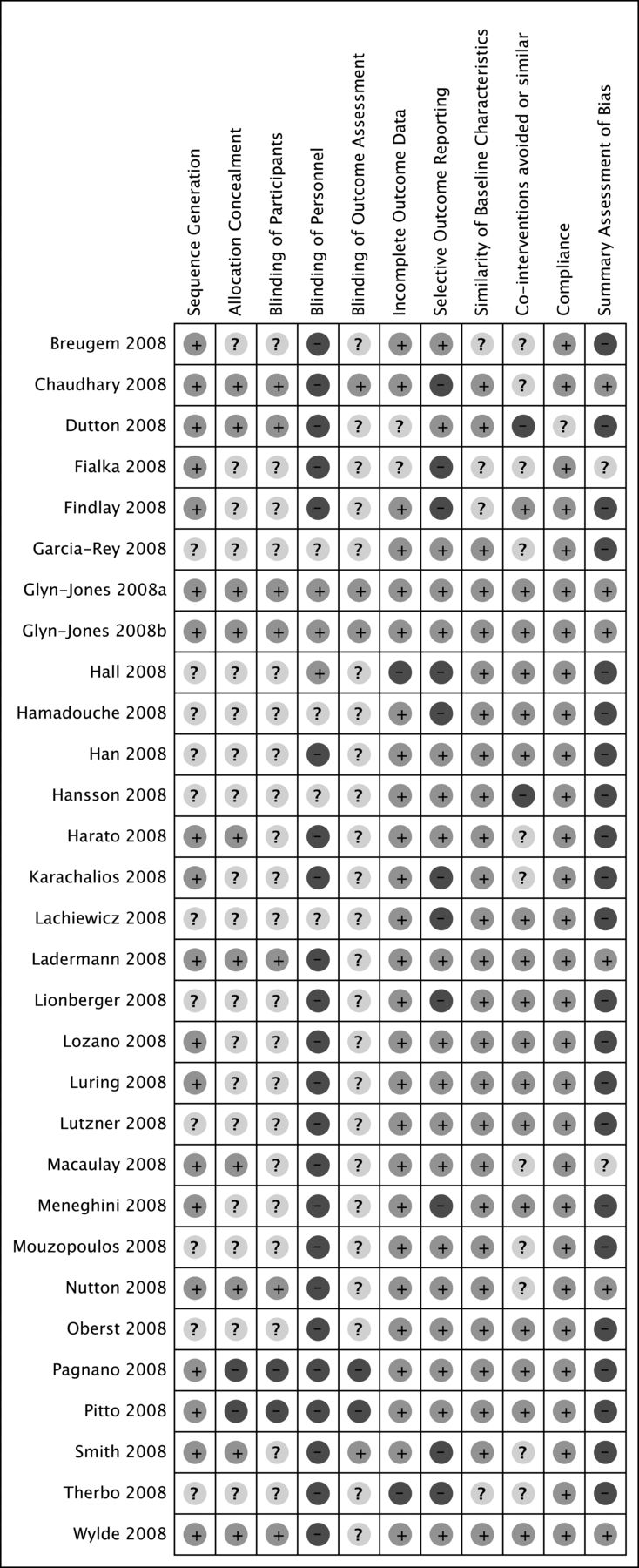
Of the 30 trials published in 2008, 6 (20%) were judged to be at low overall risk of bias, and the remainder were all judged to be at high or unclear overall risk of bias (Figure 2). Four (21%) of the 19 knee trials36,39,42,43 and 2 (20%) of the 10 hip trials40,41 were judged to be at low risk of bias. In the 1 shoulder joint trial25, the risk of bias was deemed unclear.
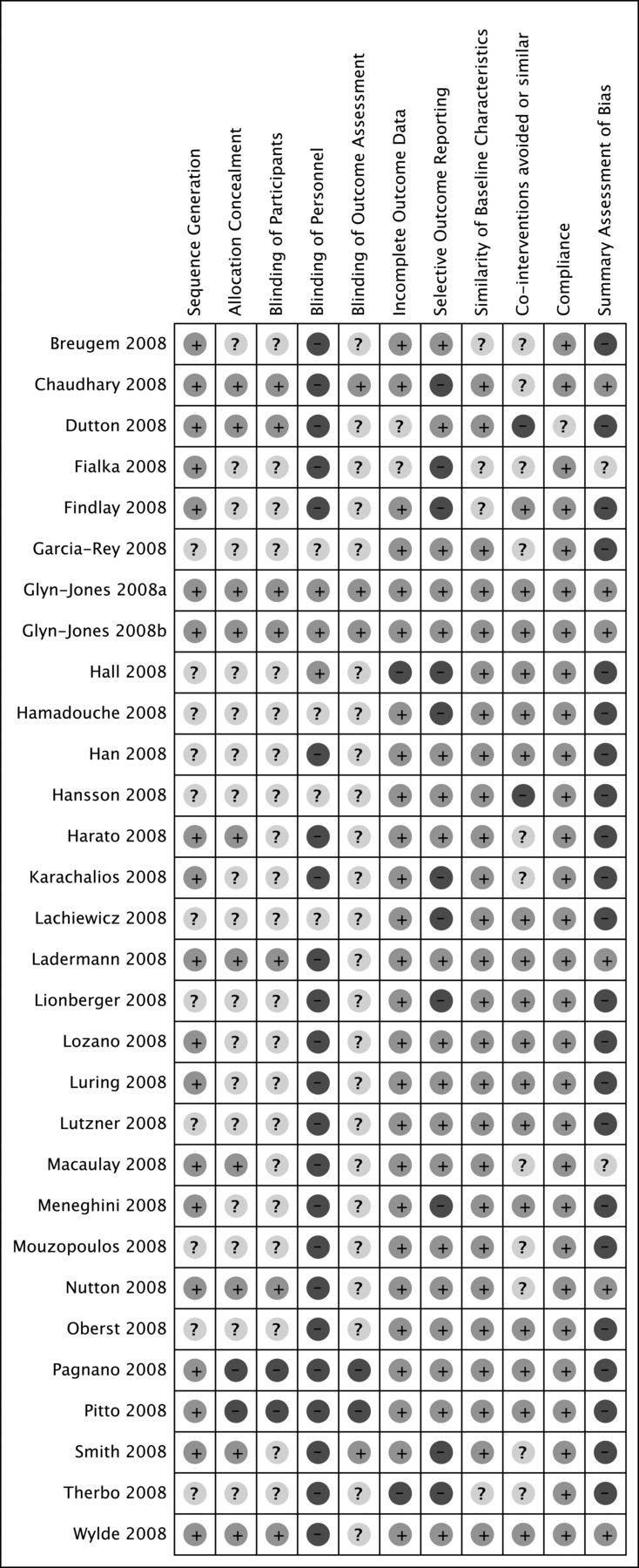
Information on trials published in 2008. Symbols refer to risk of bias: + is high risk, – is low risk, ? is unclear risk.
  • Download figure
  • Open in new tab
  • Download powerpoint
Figure 2.

Information on trials published in 2008. Symbols refer to risk of bias: + is high risk, – is low risk, ? is unclear risk.

Of the 40 trials published in 2013, only 6 (15%) were judged to be at low overall risk of bias (Figure 3). Three (15%) of the 20 knee trials were judged to be at low overall risk of bias56,58,77, 11 (55%) were deemed unclear48,57,64,66,68,69,70,71a,73,76,81, and 6 (30%) were judged to be at high risk of bias49,54,61,71,74,75. Three (21%) of the 17 hip trials were judged to be at low overall risk of bias56,58,77, 6 (43%) were deemed unclear46,47,59,60,62,80, and 8 (57%) were judged to be at high risk of bias44,51,52,53,63,67,72,79. One shoulder trial was deemed unclear82 and 1 was judged to be at high overall risk of bias78, while the single wrist trial was also judged to be at high overall risk of bias50.

Information on trials published in 2013. Symbols refer to risk of bias: + is high risk, – is low risk, ? is unclear risk.
  • Download figure
  • Open in new tab
  • Download powerpoint
Figure 3.

Information on trials published in 2013. Symbols refer to risk of bias: + is high risk, – is low risk, ? is unclear risk.

Figure 4 compares the number of trials with low risk of bias for each risk of bias domain and overall low risk of bias according to publication year. There was no difference between years in number of trials judged to be at overall low risk of bias (6/30 in 2008 compared with 6/40 in 2013, chi-square = 0.302, p = 0.75). The method used to generate the random sequence was adequately reported in 63% of the 2008 trials and 53% of the 2013 trials; however, details of allocation concealment were reported in only 10 trials (33%) in 2008 and 12 (30%) in 2013. More trials reported blinding of patients (n = 13, 33%) and outcomes (n = 14, 35%) in 2013 in comparison with 2008 [n = 17 (23%) and n = 4 (13%), respectively]. Twenty-six trials (87%) in 2008 reported detailed baseline characteristics; however, this applied to only 22 (55%) of the 2013 trials. Few trials prespecified or reported the use of relevant cointerventions [n = 13 (43%) in 2008, n = 9 (22%) in 2013], or described how incomplete data were addressed [n = 4 (13%) in 2008, n = 14 (35%) in 2013]. Several trials also had evidence of selective outcome reporting [n = 11 (37%) in 2008, n = 9 (22%) in 2013]. These issues may have influenced outcomes.

Number of trials with low risk of bias for different criteria in the Cochrane Risk of Bias tool comparing 2008 and 2013 joint replacement randomized controlled trials.
  • Download figure
  • Open in new tab
  • Download powerpoint
Figure 4.

Number of trials with low risk of bias for different criteria in the Cochrane Risk of Bias tool comparing 2008 and 2013 joint replacement randomized controlled trials.

Primary outcomes

A summary of the primary outcomes reported in the 2008 and 2013 trials is shown in Table 2. Compared with trials published in 2008, more trials published in 2013 reported a primary outcome [n = 22/40 (55%) compared with n = 5/30 (17%), chi-square = 10.6316, p = 0.001]. Four out of 19 knee trials (21%) specified a primary outcome in 2008 compared with 11/20 knee trials (55%) in 2013. In these 15 knee trials, 17 different primary outcomes were specified despite evaluating similar questions. Within each time period, only 2 trials reported the same primary outcome (knee range of motion was specified in 2 trials in 2008 and difference in mechanical axis deviation measured in degrees in the coronal plane on radiographs in 2 trials in 2013). No primary outcome was used in both time periods. The majority of primary outcomes reported evaluated technical aspects of the procedures (n = 12/17, 71%) rather than patient-centered outcomes.

View this table:
  • View inline
  • View popup
Table 2.

Primary outcome measures by joint (knee, hip, shoulder, and wrist) and year of publication (2008 or 2013).

Only 1 out of 10 (10%) hip trials reported a primary outcome in 2008 compared with 8/17 (47%) hip trials in 2013. Similar to the knee trials, the primary outcomes varied widely and were focused on technical outcomes of the procedure. Primary outcomes used in more than 1 hip trial included component migration [radiostereometric analysis (RSA), n = 3], deviation ≥ 5° of planned stem shaft angle (radiographs; n = 2), computerized gait assessment (mean gait velocity, stride length; n = 2), and revision rates (n = 2). Assessment of component migration was the only primary outcome measure used in both time periods.

Two of the 3 shoulder trials reported a primary outcome. Only the two 2013 trials evaluating shoulder joint replacement surgery reported a primary outcome, and each trial used a different measure to assess “improvement” (postoperative pain on a visual analog scale 0–10 mm and healing rate of the subscapularis tendon visualized on magnetic resonance imaging). The single wrist trial reported a primary outcome and used RSA to measure component migration in mm.

DISCUSSION

We observed a significant difference in the frequency of reporting of primary outcomes in joint replacement trials in 2013 compared with 2008. Only 17% (21% knee and 10% hip) of RCT published in 2008 reported a primary outcome measure in comparison with 55% (55% knee and 47% hip) in 2013. Without knowledge of the frequency of reporting before 2008 and between 2008 and 2013, it is not possible to know with certainty whether the improved reporting in 2013 reflects a real improvement over time. Nevertheless, almost half of all joint replacement trials continue to fail to specify a primary outcome despite widely accepted CONSORT recommendations9,83. Similar inadequate reporting of primary outcomes has been shown in other surgical fields including ophthalmic surgery84, solid organ transplantation85, plastic surgery86, urology87, trauma surgery88, and neurosurgery89.

In addition, we found that among trials that did specify 1 or more primary outcomes, these varied widely despite the trials addressing similar research questions. In both years (2008 and 2013), no primary outcome measure was used in more than 2 trials despite similar research questions. This heterogeneity in primary outcome reporting is consistent with results from a previous systematic review6. Heterogeneity in outcome measurement hampers our ability to combine, contrast, and accurately interpret the results from multiple RCT answering the same (and sometimes similar) research questions. To improve the quality of information available for patients undergoing joint replacement surgery, RCT evaluating the same clinical questions need to use a homogeneous set of outcome measures. Further efforts are required to achieve this10.

Further, the majority of primary outcomes reported were predominantly focused on technical aspects of the surgery. Hence, despite the significant investment of time, money, and resources in evaluating these important research questions, we found that the majority of trials in our systematic review were not designed or powered to evaluate other important core domains of health for both the patient and society.

Few trials published in both 2008 and 2013 were judged to be at low overall risk of bias (20% in 2008 and 15% in 2013). Not surprisingly, the trials at less potential for bias were more likely to report a primary outcome measure. In addition, almost a quarter of the trials we included (20/70, 23%) were judged to be at unclear risk of bias because they reported insufficient information. While it is often not possible in surgical RCT to blind the investigators to the group assignments or standardize surgical techniques, it should be possible to minimize other potential sources of bias. Common areas of potential bias occurring in more than 50% of the studies included failing to describe allocation concealment, participant blinding, how incomplete data were addressed, and selective reporting of outcomes. Lack of adequate reporting of details of randomization, allocation concealment, blinding, cointervention use, and outcomes is not limited to joint replacement trials or orthopedic surgery84,87,88,89,90,91,92,93.

Our study had several limitations. First, while we used a comprehensive systematic search strategy to identify all relevant studies, we excluded foreign language publications. Given the high proportion of papers published in English-language journals (80%–90%), this is unlikely to affect generalizability94. Second, the majority of joint replacement trials in our review involved hip and knee surgery. There were limited trials evaluating the shoulder, wrist, and hand, and no trials evaluating elbow or ankle joint replacement. Therefore, our results may or may not be generalizable to joint replacement trials of other joints. Third, in selecting 2 publication years, there is a possibility that this literature may not have been truly representative of periods just before, between, and after these dates. The 5-year gap between study years may not have been long enough to identify meaningful change; however, we chose the start year as the year of publication of the study that showed poor quality of arthroplasty trials6. More studies may be needed in the future with a longer interval to look for improvements using the same quality criteria. Our results are, however, consistent with previous reviews. Finally, we judged risk of bias and specification of primary outcomes on the basis of the published paper. It may be that we overestimated potential for bias and underestimated frequency of primary outcome specification because of poor reporting practices rather than suboptimal trial methodology. However, we tried to limit this effect by also searching the trial registries for protocols.

Despite an observed increase in frequency of reporting of primary outcome measures in joint replacement trials in 2013 compared with 2008, almost 50% of trials published in 2013 did not report their primary outcomes. In addition, among trials that did report primary outcomes, these were heterogeneous, frequently measured technical aspects of surgery rather than patient important endpoints, and few trials used the same primary outcome even for similar research questions. In addition, the majority of trials published in both years were at high or unclear overall risk of bias and reflect a lack of implementation of quality improvement initiatives such as the CONSORT guidelines (or similar). Further efforts are needed to improve the quality of joint replacement trials and ensure primary outcomes are reported. A standardized, universally accepted core set of outcomes to be used in all joint replacement trials based upon their clinical relevance would enhance this field.

Acknowledgment

Co-author Dr. Andrew P. Sprowson died tragically on March 13, 2015. The authors remember him as an orthopedic surgeon with immense enthusiasm for research and for robust clinical evidence in the field of joint replacement surgery. He was an integral part of the Working Group for Joint Arthroplasty within the Outcome Measures in Rheumatology, and a great friend.

APPENDIX 1.

View this table:
  • View inline
  • View popup
APPENDIX 1.

Characteristics of joint replacement randomized controlled trials published in 2008 and 2013.

  • Accepted for publication April 12, 2017.

REFERENCES

  1. 1.↵
    1. Kurtz S,
    2. Ong K,
    3. Lau E,
    4. Mowat F,
    5. Halpern M
    . Projections of primary and revision hip and knee arthroplasty in the United States from 2005 to 2030. J Bone Joint Surg Am 2007;89:780–5.
    OpenUrlAbstract/FREE Full Text
  2. 2.↵
    1. Britton A,
    2. McKee M,
    3. Black N,
    4. McPherson K,
    5. Sanderson C,
    6. Bain C
    . Choosing between randomised and non-randomised studies: a systematic review. Health Technol Assess 1998;2:i–iv, 1–124.
    OpenUrlPubMed
  3. 3.↵
    1. Ross S,
    2. Grant A,
    3. Counsell C,
    4. Gillespie W,
    5. Russell I,
    6. Prescott R
    . Barriers to participation in randomised controlled trials: a systematic review. J Clin Epidemiol 1999;52:1143–56.
    OpenUrlCrossRefPubMed
  4. 4.
    1. Mapstone J,
    2. Elbourne D,
    3. Roberts I
    . Strategies to improve recruitment to research studies. Cochrane Database Syst Rev 2007:MR000013.
  5. 5.↵
    1. Treweek S,
    2. Mitchell E,
    3. Pitkethly M,
    4. Cook J,
    5. Kjeldstrom M,
    6. Taskila T,
    7. et al.
    Strategies to improve recruitment to randomised controlled trials. Cochrane Database Syst Rev 2010:MR000013.
  6. 6.↵
    1. Riddle DL,
    2. Stratford PW,
    3. Bowman DH
    . Findings of extensive variation in the types of outcome measures used in hip and knee replacement clinical trials: a systematic review. Arthritis Rheum 2008;59:876–83.
    OpenUrlCrossRefPubMed
  7. 7.↵
    1. Riddle DL,
    2. Stratford PW,
    3. Singh JA,
    4. Strand CV
    . Variation in outcome measures in hip and knee arthroplasty clinical trials: a proposed approach to achieving consensus. J Rheumatol 2009;36:2050–6.
    OpenUrlAbstract/FREE Full Text
  8. 8.↵
    1. Gossec L,
    2. Paternotte S,
    3. Bingham CO 3rd,
    4. Clegg DO,
    5. Coste P,
    6. Conaghan PG,
    7. et al;
    8. OARSI-OMERACT Task Force Total Articular Replacement as Outcome Measure in OA
    . OARSI/OMERACT initiative to define states of severity and indication for joint replacement in hip and knee osteoarthritis. An OMERACT 10 Special Interest Group. J Rheumatol 2011;38:1765–9.
    OpenUrlAbstract/FREE Full Text
  9. 9.↵
    1. Schulz KF,
    2. Altman DG,
    3. Moher D;
    4. CONSORT Group
    . CONSORT 2010 statement: updated guidelines for reporting parallel group randomised trials. Int J Surg 2011;9:672–7.
    OpenUrlCrossRefPubMed
  10. 10.↵
    1. Singh JA,
    2. Dohm M,
    3. Sprowson AP,
    4. Wall PD,
    5. Richards BL,
    6. Gossec L,
    7. et al.
    Outcome domains and measures in total joint replacement clinical trials: can we harmonize them? An OMERACT collaborative initiative. J Rheumatol 2015;42:2496–502.
    OpenUrlAbstract/FREE Full Text
  11. 11.↵
    1. Boers M,
    2. Kirwan JR,
    3. Wells G,
    4. Beaton D,
    5. Gossec L,
    6. d’Agostino MA,
    7. et al.
    Developing core outcome measurement sets for clinical trials: OMERACT filter 2.0. J Clin Epidemiol 2014;67:745–53.
    OpenUrlCrossRefPubMed
  12. 12.↵
    1. Moher D,
    2. Liberati A,
    3. Tetzlaff J,
    4. Altman DG;
    5. PRISMA Group
    . Preferred reporting items for systematic reviews and meta-analyses: the PRISMA Statement. Open Med 2009;3:e123–30.
    OpenUrlCrossRefPubMed
  13. 13.↵
    1. Higgins JP,
    2. Green S
    , eds. Cochrane handbook for systematic reviews of interventions version 5.1.0. [Internet. Accessed April 25, 2017.] The Cochrane Collaboration; 2011. Available from: handbook.cochrane.org
  14. 14.↵
    1. Hamadouche M,
    2. Baque F,
    3. Lefevre N,
    4. Kerboull M
    . Minimum 10-year survival of Kerboull cemented stems according to surface finish. Clin Orthop Rel Res 2008;466:332–9.
    OpenUrlCrossRefPubMed
  15. 15.↵
    1. Mouzopoulos G,
    2. Stamatakos M,
    3. Arabatzi H,
    4. Vasiliadis G,
    5. Batanis G,
    6. Tsembeli A,
    7. et al.
    The four-year functional result after a displaced subcapital hip fracture treated with three different surgical options. Int Orthop 2008;32:367–73.
    OpenUrlCrossRefPubMed
  16. 16.↵
    1. Garcia-Rey E,
    2. Garcia-Cimbrelo E,
    3. Cruz-Pardos A,
    4. Ortega-Chamarro J
    . New polyethylenes in total hip replacement: a prospective, comparative clinical study of two types of liner. J Bone Joint Surg Br 2008;90:149–53.
    OpenUrlCrossRefPubMed
  17. 17.↵
    1. Breugem SJ,
    2. Sierevelt IN,
    3. Schafroth MU,
    4. Blankevoort L,
    5. Schaap GR,
    6. van Dijk CN
    . Less anterior knee pain with a mobile-bearing prosthesis compared with a fixed-bearing prosthesis. Clin Orthop Rel Res 2008;466:1959–65.
    OpenUrlCrossRefPubMed
  18. 18.↵
    1. Findlay IA,
    2. Bowman NK,
    3. Miles K,
    4. East DJ,
    5. Apthorp HD,
    6. Butler-Manuel A
    . The AGC total knee replacement-cemented versus cementless hydroxyapatite fixation. J Bone Joint Surg Br 2008;90-A:Supplement.
  19. 19.↵
    1. Hansson U,
    2. Ryd L,
    3. Toksvig-Larsen S
    . A randomised RSA study of Peri-Apatite HA coating of a total knee prosthesis. Knee 2008;15:211–6.
    OpenUrlCrossRefPubMed
  20. 20.↵
    1. Karachalios T,
    2. Giotikas D,
    3. Roidis N,
    4. Poultsides L,
    5. Bargiotas K,
    6. Malizos KN
    . Total knee replacement performed with either a mini-midvastus or a standard approach: A prospective randomised clinical and radiological trial. J Bone Joint Surg Br 2008;90:584–91.
    OpenUrlCrossRefPubMed
  21. 21.↵
    1. Lützner J,
    2. Krummenauer F,
    3. Wolf C,
    4. Günther KP,
    5. Kirschner S
    . Computer-assisted and conventional total knee replacement: a comparative, prospective, randomised study with radiological and CT evaluation. J Bone Joint Surg Br 2008;90:1039–44.
    OpenUrlCrossRefPubMed
  22. 22.↵
    1. Oberst M,
    2. Bertsch C,
    3. Konrad G,
    4. Lahm A,
    5. Holz U
    . CT analysis after navigated versus conventional implantation of TKA. Arch Orthop Trauma Surg 2008;128:561–6.
    OpenUrl
  23. 23.↵
    1. Lozano LM,
    2. Segur JM,
    3. Macule F,
    4. Nunez M,
    5. Torner P,
    6. Castillo F,
    7. et al.
    Intramedullary versus extramedullary tibial cutting guide in severely obese patients undergoing total knee replacement: a randomized study of 70 patients with body mass index >35 kg/m2. Obes Surg 2008;18:1599–604.
    OpenUrlPubMed
  24. 24.↵
    1. Lüring C,
    2. Beckmann J,
    3. Haiböck P,
    4. Perlick L,
    5. Grifka J,
    6. Tingart M
    . Minimal invasive and computer assisted total knee replacement compared with the conventional technique: A prospective, randomised trial. Knee Surg Sports Traumatol Arthrosc 2008;16:928–34.
    OpenUrlCrossRefPubMed
  25. 25.↵
    1. Fialka C,
    2. Stampfl P,
    3. Arbes S,
    4. Reuter P,
    5. Oberleitner G,
    6. Vécsei V
    . Primary hemiarthroplasty in four-part fractures of the proximal humerus: Randomized trial of two different implant systems. J Shoulder Elbow Surg 2008;17:210–5.
    OpenUrlCrossRefPubMed
  26. 26.↵
    1. Therbo M,
    2. Lund B,
    3. Jensen KE,
    4. Schrøder HM
    . Effect of bioactive coating of the tibial component on migration pattern in uncemented total knee arthroplasty: A randomized RSA study of 14 knees presented according to new RSA-guidelines. J Orthop Traumatol 2008;9:63–7.
    OpenUrlCrossRefPubMed
  27. 27.↵
    1. Meneghini RM,
    2. Smits SA,
    3. Swinford RR,
    4. Bahamonde RE
    . A randomized, prospective study of 3 minimally invasive surgical approaches in total hip arthroplasty: comprehensive gait analysis. J Arthroplasty 2008;23 Suppl 1:68–73.
    OpenUrlCrossRefPubMed
  28. 28.↵
    1. Pagnano MW,
    2. Trousdale RT,
    3. Meneghini RM,
    4. Hanssen AD
    . Slower recovery after two-incision than mini-posterior-incision total hip arthroplasty. A randomized clinical trial. J Bone Joint Surg Am 2008;90:1000–6.
    OpenUrlAbstract/FREE Full Text
  29. 29.↵
    1. Lionberger DR,
    2. Weise J,
    3. Ho DM,
    4. Haddad JL
    . How does electromagnetic navigation stack up against infrared navigation in minimally invasive total knee arthroplasties? J Arthroplasty 2008;23:573–80.
    OpenUrlCrossRefPubMed
  30. 30.↵
    1. Hall J,
    2. Copp SN,
    3. Adelson WS,
    4. D’Lima DD,
    5. Colwell CW Jr
    . Extensor mechanism function in single-radius vs multiradius femoral components for total knee arthroplasty. J Arthroplasty 2008;23:216–9.
    OpenUrlPubMed
  31. 31.↵
    1. Lachiewicz PF,
    2. Kelley SS,
    3. Soileau ES
    . Survival of polished compared with precoated roughened cemented femoral components. A prospective, randomized study. J Bone Joint Surg Am 2008;90:1457–63.
    OpenUrlAbstract/FREE Full Text
  32. 32.↵
    1. Macaulay W,
    2. Nellans KW,
    3. Garvin KL,
    4. Iorio R,
    5. Healy WL,
    6. Rosenwasser MP;
    7. other members of the DFACTO Consortium
    . Prospective randomized clinical trial comparing hemiarthroplasty to total hip arthroplasty in the treatment of displaced femoral neck fractures: winner of the Dorr Award. J Arthroplasty 2008;23 Suppl 1:2–8.
    OpenUrlCrossRefPubMed
  33. 33.↵
    1. Han I,
    2. Seong SC,
    3. Lee S,
    4. Yoo JH,
    5. Lee MC
    . Simultaneous bilateral MIS-TKA results in faster functional recovery. Clin Orthop Relat Res 2008;466:1449–53.
    OpenUrlCrossRefPubMed
  34. 34.↵
    1. Dutton AQ,
    2. Yeo SJ,
    3. Yang KY,
    4. Lo NN,
    5. Chia KU,
    6. Chong HC
    . Computer-assisted minimally invasive total knee arthroplasty compared with standard total knee arthroplasty. A prospective, randomized study. J Bone Joint Surg Am 2008;90:2–9.
    OpenUrlAbstract/FREE Full Text
  35. 35.↵
    1. Harato K,
    2. Bourne RB,
    3. Victor J,
    4. Snyder M,
    5. Hart J,
    6. Ries MD
    . Midterm comparison of posterior cruciate-retaining versus-substituting total knee arthroplasty using the Genesis II prosthesis. A multicenter prospective randomized clinical trial. Knee 2008;15:217–21.
    OpenUrlCrossRefPubMed
  36. 36.↵
    1. Chaudhary R,
    2. Beaupré LA,
    3. Johnston DW
    . Knee range of motion during the first two years after use of posterior cruciate-stabilizing or posterior cruciate-retaining total knee prostheses. A randomized clinical trial. J Bone Joint Surg Am 2008;90:2579–86.
    OpenUrlAbstract/FREE Full Text
  37. 37.↵
    1. Smith AJ,
    2. Wood DJ,
    3. Li MG
    . Total knee replacement with and without patellar resurfacing: a prospective, randomised trial using the profix total knee system. J Bone Joint Surg Br 2008;90:43–9.
    OpenUrlPubMed
  38. 38.↵
    1. Pitto RP,
    2. Bhargava A,
    3. Pandit S,
    4. Munro JT
    . Retroacetabular stress-shielding in THA. Clin Orthop Relat Res 2008;466:353–8.
    OpenUrlCrossRefPubMed
  39. 39.↵
    1. Wylde V,
    2. Learmonth I,
    3. Potter A,
    4. Bettinson K,
    5. Lingard E
    . Patient-reported outcomes after fixed- versus mobile-bearing total knee replacement: a multi-centre randomised controlled trial using the Kinemax total knee replacement. J Bone Joint Surg Br 2008;90:1172–9.
    OpenUrlCrossRefPubMed
  40. 40.↵
    1. Glyn-Jones S,
    2. Isaac S,
    3. Hauptfleisch J,
    4. McLardy-Smith P,
    5. Murray DW,
    6. Gill HS
    . Does highly cross-linked polyethylene wear less than conventional polyethylene in total hip arthroplasty? A double-blind, randomized, and controlled trial using roentgen stereophotogrammetric analysis. J Arthroplasty 2008;23:337–43.
    OpenUrlCrossRefPubMed
  41. 41.↵
    1. Glyn-Jones S,
    2. McLardy-Smith P,
    3. Gill HS,
    4. Murray DW
    . The creep and wear of highly cross-linked polyethylene: a three-year randomised, controlled trial using radiostereometric analysis. J Bone Joint Surg Br 2008;90:556–61.
    OpenUrlCrossRefPubMed
  42. 42.↵
    1. Nutton RW,
    2. van der Linden ML,
    3. Rowe PJ,
    4. Gaston P,
    5. Wade FA
    . A prospective randomised double-blind study of functional outcome and range of flexion following total knee replacement with the NexGen standard and high flexion components. J Bone Joint Surg Br 2008;90:37–42.
    OpenUrlCrossRefPubMed
  43. 43.↵
    1. Lädermann A,
    2. Lübbeke A,
    3. Stern R,
    4. Riand N,
    5. Fritschy D
    . Fixed-bearing versus mobile-bearing total knee arthroplasty: a prospective randomised, clinical and radiological study with mid-term results at 7 years. Knee 2008;15:206–10.
    OpenUrlCrossRefPubMed
  44. 44.↵
    1. Bjorgul K,
    2. Novicoff WN,
    3. Andersen ST,
    4. Ahlund OR,
    5. Bunes A,
    6. Wiig M,
    7. et al.
    High rate of revision and a high incidence of radiolucent lines around Metasul metal-on-metal total hip replacements: results from a randomised controlled trial of three bearings after seven years. Bone Joint J 2013;95-B:881–6.
    OpenUrlCrossRefPubMed
  45. 45.↵
    1. Breeman S,
    2. Campbell MK,
    3. Dakin H,
    4. Fiddian N,
    5. Fitzpatrick R,
    6. Grant A,
    7. et al;
    8. KAT Trial Group
    . Five-year results of a randomised controlled trial comparing mobile and fixed bearings in total knee replacement. Bone Joint J 2013;95-B:486–92.
    OpenUrlPubMed
  46. 46.↵
    1. Cadossi M,
    2. Chiarello E,
    3. Savarino L,
    4. Tedesco G,
    5. Baldini N,
    6. Faldini C,
    7. et al.
    A comparison of hemiarthroplasty with a novel polycarbonate-urethane acetabular component for displaced intracapsular fractures of the femoral neck: a randomised controlled trial in elderly patients. Bone Joint J 2013;95-B:609–15.
    OpenUrlPubMed
  47. 47.↵
    1. Desmarchelier R,
    2. Viste A,
    3. Chouteau J,
    4. Lerat JL,
    5. Fessy MH
    . Metasul vs Cerasul bearings: a prospective, randomized study at 9 years. J Arthroplasty 2013;28:296–302.
    OpenUrl
  48. 48.↵
    1. Fischer M,
    2. von Eisenhart-Rothe R,
    3. Simank HG
    . Comparable short-term results seen with standard and high-flexion knee arthroplasty designs in European patients. J Orthop 2013;10:119–22.
    OpenUrl
  49. 49.↵
    1. Hamilton DF,
    2. Simpson AH,
    3. Burnett R,
    4. Patton JT,
    5. Moran M,
    6. Clement ND,
    7. et al.
    Lengthening the moment arm of the patella confers enhanced extensor mechanism power following total knee arthroplasty. J Orthop Res 2013;31:1201–7.
    OpenUrlCrossRefPubMed
  50. 50.↵
    1. Hansen TB,
    2. Stilling M
    . Equally good fixation of cemented and uncemented cups in total trapeziometacarpal joint prostheses. A randomized clinical RSA study with 2-year follow-up. Acta Orthop 2013;84:98–105.
    OpenUrlCrossRefPubMed
  51. 51.↵
    1. Hedbeck CJ,
    2. Inngul C,
    3. Blomfeldt R,
    4. Ponzer S,
    5. Törnkvist H,
    6. Enocson A
    . Internal fixation versus cemented hemiarthroplasty for displaced femoral neck fractures in patients with severe cognitive dysfunction: a randomized controlled trial. J Orthop Traumatol 2013;27:690–5.
    OpenUrl
  52. 52.↵
    1. Inngul C,
    2. Hedbeck CJ,
    3. Blomfeldt R,
    4. Lapidus G,
    5. Ponzer S,
    6. Enocson A
    . Unipolar hemiarthroplasty versus bipolar hemiarthroplasty in patients with displaced femoral neck fractures: a four-year follow-up of a randomised controlled trial. Int Orthop 2013;37:2457–64.
    OpenUrlCrossRefPubMed
  53. 53.↵
    1. Landgraeber S,
    2. Quitmann H,
    3. Güth S,
    4. Haversath M,
    5. Kowalczyk W,
    6. Kecskeméthy A,
    7. et al.
    A prospective randomized peri- and post-operative comparison of the minimally invasive anterolateral approach versus the lateral approach. Orthop Rev 2013;5:e19.
    OpenUrl
  54. 54.↵
    1. Nieuwenhuijse MJ,
    2. van der Voort P,
    3. Kaptein BL,
    4. van der Linden-van der Zwaag HM,
    5. Valstar ER,
    6. Nelissen RG
    . Fixation of high-flexion total knee prostheses: five-year follow-up results of a four-arm randomized controlled clinical and roentgen stereophotogrammetric analysis study. J Bone Joint Surg Am 2013;95:e1411–11.
    OpenUrl
  55. 55.↵
    1. Pandit H,
    2. Liddle AD,
    3. Kendrick BJ,
    4. Jenkins C,
    5. Price AJ,
    6. Gill HS,
    7. et al.
    Improved fixation in cementless unicompartmental knee replacement: five-year results of a randomized controlled trial. J Bone Joint Surg Am 2013;95:1365–72.
    OpenUrlAbstract/FREE Full Text
  56. 56.↵
    1. Penny JØ,
    2. Ovesen O,
    3. Varmarken JE,
    4. Overgaard S
    . Similar range of motion and function after resurfacing large-head or standard total hip arthroplasty. Acta Orthop 2013;84:246–53.
    OpenUrl
  57. 57.↵
    1. Radetzki F,
    2. Wienke A,
    3. Mendel T,
    4. Gutteck N,
    5. Delank KS,
    6. Wohlrab D
    . High flex total knee arthroplasty—a prospective, randomized study with results after 10 years. Acta Orthop Belg 2013;79:536–40.
    OpenUrl
  58. 58.↵
    1. Smolders JM,
    2. Pakvis DF,
    3. Hendrickx BW,
    4. Verdonschot N,
    5. van Susante JL
    . Periacetabular bone mineral density changes after resurfacing hip arthroplasty versus conventional total hip arthroplasty. A randomized controlled DEXA study. J Arthroplasty 2013;28:1177–84.
    OpenUrl
  59. 59.↵
    1. Stiehler M,
    2. Goronzy J,
    3. Hartmann A,
    4. Krummenauer F,
    5. Günther K
    . The First SICOT Oral Presentation Award 2011: imageless computer-assisted femoral component positioning in hip resurfacing: a prospective randomised trial. Int Orthop 2013;37:569–81.
    OpenUrl
  60. 60.↵
    1. Vidovic D,
    2. Matejcic A,
    3. Punda M,
    4. Ivica M,
    5. Tomljenovic M,
    6. Bekavac-Beslin M,
    7. et al.
    Periprosthetic bone loss following hemiarthroplasty: a comparison between cemented and cementless hip prosthesis. Injury 2013;44 Suppl 3:S62–6.
    OpenUrl
  61. 61.↵
    1. Hamilton DF,
    2. Clement ND,
    3. Burnett R,
    4. Patton JT,
    5. Moran M,
    6. Howie CR,
    7. et al.
    Do modern total knee replacements offer better value for money? A health economic analysis. Int Orthop 2013;37:2147–52.
    OpenUrl
  62. 62.↵
    1. Munzinger U,
    2. Guggi T,
    3. Kaptein B,
    4. Persoon M,
    5. Valstar E,
    6. Doets HC
    . A titanium plasma-sprayed cup with and without hydroxyapatite-coating: a randomised radiostereometric study of stability and osseointegration. Hip Int 2013;23:33–9.
    OpenUrl
  63. 63.↵
    1. Zagra L,
    2. Anasetti F,
    3. Bianchi L,
    4. Licari V,
    5. Giacometti Ceroni R
    . No difference in gait recovery after THA with different head diameters: a prospective randomized study. Clin Orthop Relat Res 2013;471:3830–7.
    OpenUrl
  64. 64.↵
    1. Aggarwal AK,
    2. Agrawal A
    . Mobile vs fixed-bearing total knee arthroplasty performed by a single surgeon: a 4- to 6.5-year randomized, prospective, controlled, double-blinded study. J Arthroplasty 2013;28:1712–6.
    OpenUrlCrossRefPubMed
  65. 65.↵
    1. Chareancholvanich K,
    2. Narkbunnam R,
    3. Pornrattanamaneewong C
    . A prospective randomised controlled study of patient-specific cutting guides compared with conventional instrumentation in total knee replacement. Bone Joint J 2013;95-B:354–9.
    OpenUrlCrossRefPubMed
  66. 66.↵
    1. Jung WH,
    2. Chun CW,
    3. Lee JH,
    4. Ha JH,
    5. Jeong JH
    . The accuracy of the extramedullary and intramedullary femoral alignment system in total knee arthroplasty for varus osteoarthritic knee. Knee Surg Sports Traumatol Arthrosc 2013;21:629–35.
    OpenUrl
  67. 67.↵
    1. Kim YH,
    2. Park JW,
    3. Kulkarni SS,
    4. Kim YH
    . A randomised prospective evaluation of ceramic-on-ceramic and ceramic-on-highly cross-linked polyethylene bearings in the same patients with primary cementless total hip arthroplasty. Int Orthop 2013;37:2131–7.
    OpenUrlCrossRefPubMed
  68. 68.↵
    1. Nishizawa Y,
    2. Matsumoto T,
    3. Kubo S,
    4. Muratsu H,
    5. Matsushita T,
    6. Oka S,
    7. et al.
    The influence of patella height on soft tissue balance in cruciate-retaining and posterior-stabilised total knee arthroplasty. Int Orthop 2013;37:421–5.
    OpenUrl
  69. 69.↵
    1. Roh YW,
    2. Kim TW,
    3. Lee S,
    4. Seong SC,
    5. Lee MC
    . Is TKA using patient-specific instruments comparable to conventional TKA? A randomized controlled study of one system. Clin Orthop Rel Res 2013;471:3988–95.
    OpenUrlCrossRefPubMed
  70. 70.↵
    1. Song EK,
    2. Seon JK,
    3. Yim JH,
    4. Netravali NA,
    5. Bargar WL
    . Robotic-assisted TKA reduces postoperative alignment outliers and improves gap balance compared to conventional TKA. Clin Orthop Rel Res 2013;471:118–26.
    OpenUrlCrossRefPubMed
  71. 71.↵
    1. Umrani SP,
    2. Cho KY,
    3. Kim KI
    . Patellar eversion does not adversely affect quadriceps recovery following total knee arthroplasty. J Arthroplasty 2013;28:591–4.
    OpenUrl
  72. 71a.↵
    1. Yim JH,
    2. Song EK,
    3. Khan MS,
    4. Sun ZH,
    5. Seon JK
    . A comparison of classical and anatomical total knee alignment methods in robotic total knee arthroplasty: classical and anatomical knee alignment methods in TKA. J Arthroplasty 2013;28:932–7.
    OpenUrlPubMed
  73. 72.↵
    1. Barrett WP,
    2. Turner SE,
    3. Leopold JP
    . Prospective randomized study of direct anterior vs postero-lateral approach for total hip arthroplasty. J Arthroplasty 2013;28:1634–8.
    OpenUrlCrossRefPubMed
  74. 73.↵
    1. Dennis DA,
    2. Heekin RD,
    3. Clark CR,
    4. Murphy JA,
    5. O’Dell TL,
    6. Dwyer KA
    . Effect of implant design on knee flexion. J Arthroplasty 2013;28:429–38.
    OpenUrl
  75. 74.↵
    1. Hamilton WG,
    2. Parks NL,
    3. Saxena A
    . Patient-specific instrumentation does not shorten surgical time: a prospective, randomized trial. J Arthroplasty 2013;28 Suppl:96–100.
    OpenUrlCrossRefPubMed
  76. 75.↵
    1. Jarvis SL,
    2. Johnson-Wo AK,
    3. Onstot BR,
    4. Bhowmik-Stoker M,
    5. Shrader MW,
    6. Jacofsky MC,
    7. et al.
    Differences between standard and minimally invasive parapatellar surgical approaches for total knee arthroplasty in the tasks of sitting and standing. J Knee Surg 2013;26:249–56.
    OpenUrl
  77. 76.↵
    1. Wegrzyn J,
    2. Parratte S,
    3. Coleman-Wood K,
    4. Kaufman KR,
    5. Pagnano MW
    . The John Insall award: no benefit of minimally invasive TKA on gait and strength outcomes: a randomized controlled trial. Clin Orthop Relat Res 2013;471:46–55.
    OpenUrl
  78. 77.↵
    1. Greidanus NV,
    2. Chihab S,
    3. Garbuz DS,
    4. Masri BA,
    5. Tanzer M,
    6. Gross AE,
    7. et al.
    Outcomes of minimally invasive anterolateral THA are not superior to those of minimally invasive direct lateral and posterolateral THA. Clin Orthop Relat Res 2013;471:463–71.
    OpenUrl
  79. 78.↵
    1. Lapner PL,
    2. Sabri E,
    3. Rakhra K,
    4. Bell K,
    5. Athwal GS
    . Healing rates and subscapularis fatty infiltration after lesser tuberosity osteotomy versus subscapularis peel for exposure during shoulder arthroplasty. J Shoulder Elbow Surg 2013;22:396–402.
    OpenUrlCrossRefPubMed
  80. 79.↵
    1. Naudie DD,
    2. Somerville L,
    3. Korczak A,
    4. Yuan X,
    5. McCalden RW,
    6. Holdsworth D,
    7. et al.
    A randomized trial comparing acetabular component fixation of two porous ingrowth surfaces using RSA. J Arthroplasty 2013;28 Suppl:48–52.
    OpenUrl
  81. 80.↵
    1. Vendittoli PA,
    2. Riviere C,
    3. Lavigne M,
    4. Lavoie P,
    5. Alghamdi A,
    6. Duval N
    . Alumina on alumina versus metal on conventional polyethylene: a randomized clinical trial with 9 to 15 years follow-up. Acta Orthop Belg 2013;79:181–90.
    OpenUrl
  82. 81.↵
    1. Joseph J,
    2. Simpson PM,
    3. Whitehouse SL,
    4. English HW,
    5. Donnelly WJ
    . The use of navigation to achieve soft tissue balance in total knee arthroplasty - a randomised clinical study. Knee 2013;20:401–6.
    OpenUrl
  83. 82.↵
    1. Soliman OA,
    2. Koptan WM
    . Proximal humeral fractures treated with hemiarthroplasty: does tenodesis of the long head of the biceps improve results? Injury 2013;44:461–4.
    OpenUrl
  84. 83.↵
    1. Moher D,
    2. Schulz KF,
    3. Altman DG;
    4. CONSORT Group (Consolidated Standards of Reporting Trials)
    . The CONSORT statement: revised recommendations for improving the quality of reports of parallel-group randomized trials. Ann Intern Med 2001;134:657–62.
    OpenUrlCrossRefPubMed
  85. 84.↵
    1. Yao AC,
    2. Khajuria A,
    3. Camm CF,
    4. Edison E,
    5. Agha R
    . The reporting quality of parallel randomised controlled trials in ophthalmic surgery in 2011: a systematic review. Eye 2014;28:1341–9.
    OpenUrlCrossRefPubMed
  86. 85.↵
    1. Liu LQ,
    2. Morris PJ,
    3. Pengel LH
    . Compliance to the CONSORT statement of randomized controlled trials in solid organ transplantation: a 3-year overview. Transpl Int 2013;26:300–6.
    OpenUrl
  87. 86.↵
    1. Agha RA,
    2. Camm CF,
    3. Doganay E,
    4. Edison E,
    5. Siddiqui MR,
    6. Orgill DP
    . Randomised controlled trials in plastic surgery: a systematic review of reporting quality. Eur J Plast Surg 2014;37:55–62.
    OpenUrlCrossRefPubMed
  88. 87.↵
    1. Zavitsanos PJ,
    2. Bird VG,
    3. Mince KA,
    4. Neuberger MM,
    5. Dahm P
    . Low methodological and reporting quality of randomized, controlled trials of devices to treat urolithiasis. J Urol 2014;191:988–93.
    OpenUrl
  89. 88.↵
    1. Lee SY,
    2. Teoh PJ,
    3. Camm CF,
    4. Agha RA
    . Compliance of randomized controlled trials in trauma surgery with the CONSORT statement. J Trauma Acute Care Surg 2013;75:562–72.
    OpenUrlCrossRefPubMed
  90. 89.↵
    1. Kiehna EN,
    2. Starke RM,
    3. Pouratian N,
    4. Dumont AS
    . Standards for reporting randomized controlled trials in neurosurgery. J Neurosurg 2011;114:280–5.
    OpenUrlCrossRefPubMed
  91. 90.↵
    1. Camm CF,
    2. Chen Y,
    3. Sunderland N,
    4. Nagendran M,
    5. Maruthappu M,
    6. Camm AJ
    . An assessment of the reporting quality of randomised controlled trials relating to anti-arrhythmic agents (2002–2011). Int J Cardiol 2013;168:1393–6.
    OpenUrl
  92. 91.↵
    1. Hopewell S,
    2. Dutton S,
    3. Yu LM,
    4. Chan AW,
    5. Altman DG
    . The quality of reports of randomised trials in 2000 and 2006: comparative study of articles indexed in PubMed. BMJ 2010;340:c723.
    OpenUrlAbstract/FREE Full Text
  93. 92.↵
    1. Peters JP,
    2. Hooft L,
    3. Grolman W,
    4. Stegeman I
    . Assessment of the quality of reporting of randomised controlled trials in otorhinolaryngologic literature - adherence to the CONSORT statement. PLoS One 2015;10:e0122328.
    OpenUrl
  94. 93.↵
    1. Chan AW,
    2. Altman DG
    . Epidemiology and reporting of randomised trials published in PubMed journals. Lancet 2005;365:1159–62.
    OpenUrlCrossRefPubMed
  95. 94.↵
    1. Montgomery S
    . Of towers, walls, and fields: perspectives on language in science. Science 2004;303:1333–5.
    OpenUrlAbstract/FREE Full Text
PreviousNext
Back to top

In this issue

The Journal of Rheumatology
Vol. 44, Issue 8
1 Aug 2017
  • Table of Contents
  • Table of Contents (PDF)
  • Index by Author
  • Editorial Board (PDF)
Print
Download PDF
Article Alerts
Sign In to Email Alerts with your Email Address
Email Article

Thank you for your interest in spreading the word about The Journal of Rheumatology.

NOTE: We only request your email address so that the person you are recommending the page to knows that you wanted them to see it, and that it is not junk mail. We do not capture any email address.

Enter multiple addresses on separate lines or separate them with commas.
Outcome Measures Used in Arthroplasty Trials: Systematic Review of the 2008 and 2013 Literature
(Your Name) has forwarded a page to you from The Journal of Rheumatology
(Your Name) thought you would like to see this page from the The Journal of Rheumatology web site.
CAPTCHA
This question is for testing whether or not you are a human visitor and to prevent automated spam submissions.
Citation Tools
Outcome Measures Used in Arthroplasty Trials: Systematic Review of the 2008 and 2013 Literature
Bethan L. Richards, Peter D.H. Wall, Andrew P. Sprowson, Jasvinder A. Singh, Rachelle Buchbinder
The Journal of Rheumatology Aug 2017, 44 (8) 1277-1287; DOI: 10.3899/jrheum.161477

Citation Manager Formats

  • BibTeX
  • Bookends
  • EasyBib
  • EndNote (tagged)
  • EndNote 8 (xml)
  • Medlars
  • Mendeley
  • Papers
  • RefWorks Tagged
  • Ref Manager
  • RIS
  • Zotero

 Request Permissions

Share
Outcome Measures Used in Arthroplasty Trials: Systematic Review of the 2008 and 2013 Literature
Bethan L. Richards, Peter D.H. Wall, Andrew P. Sprowson, Jasvinder A. Singh, Rachelle Buchbinder
The Journal of Rheumatology Aug 2017, 44 (8) 1277-1287; DOI: 10.3899/jrheum.161477
del.icio.us logo Twitter logo Facebook logo  logo Mendeley logo
  • Tweet Widget
  •  logo
Bookmark this article

Jump to section

  • Article
    • Abstract
    • MATERIALS AND METHODS
    • RESULTS
    • DISCUSSION
    • Acknowledgment
    • APPENDIX 1.
    • REFERENCES
  • Figures & Data
  • Info & Metrics
  • References
  • PDF

Keywords

ARTHROPLASTY TRIALS
SYSTEMATIC REVIEW
OUTCOME MEASURES

Related Articles

Cited By...

More in this TOC Section

  • Palliative Care in Rheumatology: Perspectives of Rheumatologists and Palliative Care Clinicians Across the United States
  • “It’s Like a One-Stop-Shop”: A Qualitative Study Exploring Patient Experiences With Interdisciplinary Team–Based Rheumatology Care
  • The Problem of Pain in Rheumatology: Variations in Case Definitions Derived From Chronic Pain Phenotyping Algorithms Using Electronic Health Records
Show more Other Arthritides

Similar Articles

Keywords

  • ARTHROPLASTY TRIALS
  • systematic review
  • outcome measures

Content

  • First Release
  • Current
  • Archives
  • Collections
  • Audiovisual Rheum
  • COVID-19 and Rheumatology

Resources

  • Guide for Authors
  • Submit Manuscript
  • Author Payment
  • Reviewers
  • Advertisers
  • Classified Ads
  • Reprints and Translations
  • Permissions
  • Meetings
  • FAQ
  • Policies

Subscribers

  • Subscription Information
  • Purchase Subscription
  • Your Account
  • Terms and Conditions

More

  • About Us
  • Contact Us
  • My Alerts
  • My Folders
  • Privacy/GDPR Policy
  • RSS Feeds
The Journal of Rheumatology
The content of this site is intended for health care professionals.
Copyright © 2025 by The Journal of Rheumatology Publishing Co. Ltd.
Print ISSN: 0315-162X; Online ISSN: 1499-2752
Powered by HighWire