Abstract
In 2016, members of the Group for Research and Assessment of Psoriasis and Psoriatic Arthritis (GRAPPA) published their updated Treatment Recommendations for Psoriatic Arthritis. This paper describes how a patient-oriented guide to those treatment recommendations was developed by GRAPPA’s patient research partners (PRP). We describe how the PRP developed a process for creating and implementing the guide. We also describe how we evaluated the diversity of the guide’s potential patient audience, i.e., where each individual was in their diagnosis and treatment needs, and how we made the patient guide attractive, readable, and available to as broad a patient audience as possible.
The Group for Research and Assessment of Psoriasis and Psoriatic Arthritis (GRAPPA) is a nonprofit international group dedicated to advancing education, research, diagnosis, and treatment of psoriasis and psoriatic arthritis (PsA). GRAPPA members first published treatment recommendations for PsA in 20091. Following a major review of new research and therapies made available after 2009, members published an update of those recommendations in 20162.
GRAPPA member Dr. Laura C. Coates delivered a presentation on the updated treatment recommendations at the group’s 2015 annual meeting, shortly before they were finalized. That presentation generated interest and discussion among the GRAPPA membership, and especially among the patient research partners (PRP), who work on a voluntary basis, about the possibility of creating a patient version of the recommendations.
A Patient Perspective: How Should the Patient Guide Be Framed?
Many questions surfaced during PRP discussions about the GRAPPA recommendations. Because the recommendations are intended for clinicians, they usually appear complex and opaque to patients. The PRP considered how this information could be made understandable and easily accessible to patients. Would a patient version be helpful? Would we focus on specific group(s) of patients or present the information to a broader patient audience? What is the right blend of content for patients? Should we add background material to a patient version to ensure a comprehensive presentation? What manner of distribution would make it accessible to as many patients as possible? Should the audience also include caregivers to patients with PsA?
The core test was to decide whether producing a patient guide and making it broadly available would benefit patients with PsA and their caregivers. Our discussions concluded that it most likely would be helpful, and the project was initiated on that basis.
PRP wanted the guide to be of interest and accessible to as many categories of patients with PsA as possible, i.e., those newly diagnosed, those who recently started treatment, those having difficulty finding a treatment that worked for them, and those who were experiencing comorbidities alongside their PsA. It was also important that the guide be accessible to those persons who were close to or supporting the patient with PsA.
These factors were used to decide which segments of the GRAPPA recommendations should be adapted for inclusion in the patient guide. The team also considered how effectively each section could be translated into understandable patient-friendly content within a pamphlet-sized guide.
Among our anticipated audience of patients, we expected some would have a basic knowledge of their disease, while others, such as those newly diagnosed, might have very little. Therefore, the project team decided to provide extra support material within the guide.
We wanted the guide to help patients in several ways:
To aid patients who were feeling challenged, and to encourage them to take control over their PsA;
To assure them that, for each specific patient’s case, there was most likely more than just 1 treatment option, or would be over time;
To provide background PsA knowledge to help them as they sought, with their medical team, to find the treatment option that was optimal for their own individual circumstances.
How Should the Guide Look?
We wanted the guide to look inviting. If a copy of the guide was in a doctor’s waiting room, we wanted the patient with PsA to notice it and pick it up. Hence, we chose a simple but meaningful cover (Figure 1). We drafted the internal text to be as patient-friendly as possible.
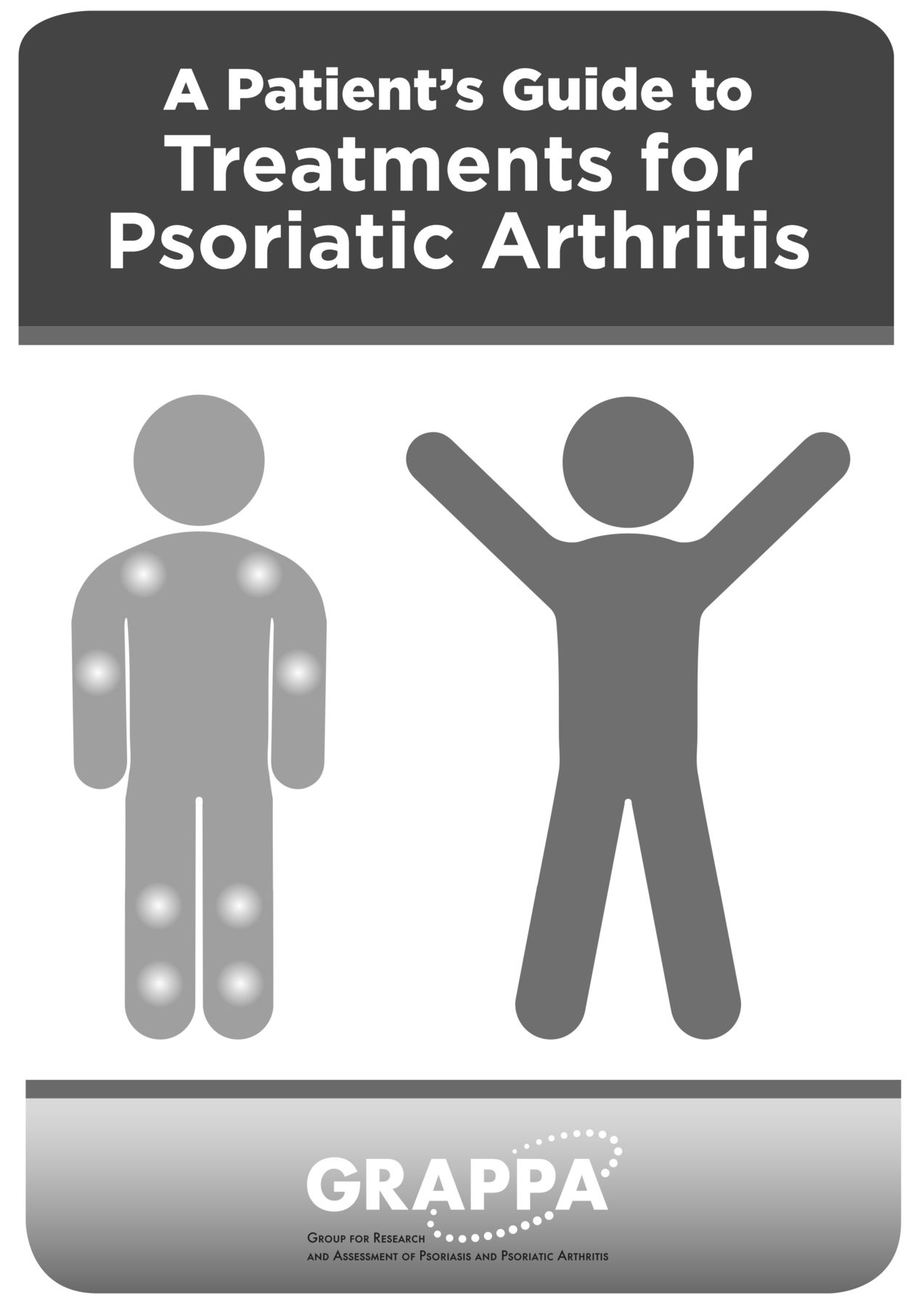
Front cover: A Patient’s Guide to Treatments for Psoriatic Arthritis.
The guide is relatively short and designed to be downloaded by anyone with Internet access. The design enables the user to print it double-sided and to fold that into a neatly sized booklet, i.e., 3 sheets of paper plus staples in the spine to create a convenient 12-page booklet; alternatively, it can be printed in standard handout form. The project team chose fonts and a page layout that would allow most printers to print legible copies of the guide, in color or monochrome. The guide is divided into reasonably sized sections and interspersed with lighthearted yet appropriate artwork. No section is spread over more than 1 page.
Individual sections address topics under the following headings: Who should read this guide? What is psoriatic arthritis? What are the goals of your treatment? What should the patient assessment include? The patient’s therapy. What types of medicines are used to treat psoriatic arthritis? Which medicines are used for each domain of the disease? Why are the 2016 treatment recommendations important? Additional therapies. Future developments. Further information.
How Should We Distribute the Guide?
We decided that the most practical method for distribution would be by the Internet, hosted on GRAPPA’s Website. To support local printing of the guide, we created variants for printing to both North American (8.5 × 11 inches)-sized and international (A4)-sized paper. A number of other medical research and patient support groups have requested permission to make the guide available to their members.
Creating the Guide
The PRP considered several different methods to create the guide, including contracting a technical writer to undertake the project in cooperation with some PRP members. Ultimately, the group decided to undertake the project themselves and approved a streamlined project team of 3 members who volunteered to prepare an initial working draft of the guide. This team consisted of a lead writer and 2 co-writers. Each team member brought experience in writing, editing, graphic design, and project delivery skills. The combination of member skills and a small team yielded a better quality first draft within a reasonable time period.
Considerable feedback and discussion resulted when this draft was circulated to the full group of PRP. The project team worked through multiple drafts to incorporate as many PRP suggestions as possible while balancing these against the core objectives that had been established for the guide.
Achieving a final draft of the textual content was a major milestone. Subsequently, the project team used a professional graphic designer to help with the graphic and formatting elements of the project. We found this stage equally demanding and time-consuming.
The patient guide will soon be available on the GRAPPA Website, www.grappanetwork.org, to view and download. Individual patients and healthcare providers may freely use the guide. Use for commercial purposes is prohibited without written permission.
Acknowledgment
Our fellow patient research partners helped greatly in making this project a success. Our thanks go to Maarten de Wit, Niti Goel, Jana James, and Rolly MacDonald. We also thank Pam Love, GRAPPA Executive Director; and Dr. Laura C. Coates, for her medical guidance.
Footnotes
As part of the supplement series GRAPPA 2016, this report was reviewed internally and approved by the Guest Editors for integrity, accuracy, and consistency with scientific and ethical standards.