
Main menu

  • Home
  • Content
    • First Release
    • Current
    • Archives
    • Collections
    • Audiovisual Rheum
    • 50th Volume Reprints
  • Resources
    • Guide for Authors
    • Submit Manuscript
    • Payment
    • Reviewers
    • Advertisers
    • Classified Ads
    • Reprints and Translations
    • Permissions
    • Meetings
    • FAQ
    • Policies
  • Subscribers
    • Subscription Information
    • Purchase Subscription
    • Your Account
    • Terms and Conditions
  • About Us
    • About Us
    • Editorial Board
    • Letter from the Editor
    • Duncan A. Gordon Award
    • Privacy/GDPR Policy
    • Accessibility
  • Contact Us
  • JRheum Supplements
  • Services

User menu

  • My Cart
  • Log In

Search

  • Advanced search
The Journal of Rheumatology
  • JRheum Supplements
  • Services
  • My Cart
  • Log In
The Journal of Rheumatology

Advanced Search

  • Home
  • Content
    • First Release
    • Current
    • Archives
    • Collections
    • Audiovisual Rheum
    • 50th Volume Reprints
  • Resources
    • Guide for Authors
    • Submit Manuscript
    • Payment
    • Reviewers
    • Advertisers
    • Classified Ads
    • Reprints and Translations
    • Permissions
    • Meetings
    • FAQ
    • Policies
  • Subscribers
    • Subscription Information
    • Purchase Subscription
    • Your Account
    • Terms and Conditions
  • About Us
    • About Us
    • Editorial Board
    • Letter from the Editor
    • Duncan A. Gordon Award
    • Privacy/GDPR Policy
    • Accessibility
  • Contact Us
  • Follow Jrheum on BlueSky
  • Follow jrheum on Twitter
  • Visit jrheum on Facebook
  • Follow jrheum on LinkedIn
  • Follow jrheum on YouTube
  • Follow jrheum on Instagram
  • Follow jrheum on RSS
Research ArticleArticle

A Clinical, Pathological, and Genetic Characterization of Methotrexate-associated Lymphoproliferative Disorders

Noriyuki Yamakawa, Masakazu Fujimoto, Daisuke Kawabata, Chikashi Terao, Momoko Nishikori, Ran Nakashima, Yoshitaka Imura, Naoichiro Yukawa, Hajime Yoshifuji, Koichiro Ohmura, Takao Fujii, Toshiyuki Kitano, Tadakazu Kondo, Kimiko Yurugi, Yasuo Miura, Taira Maekawa, Hiroh Saji, Akifumi Takaori-Kondo, Fumihiko Matsuda, Hironori Haga and Tsuneyo Mimori
The Journal of Rheumatology February 2014, 41 (2) 293-299; DOI: https://doi.org/10.3899/jrheum.130270
Noriyuki Yamakawa
From the Department of Rheumatology and Clinical Immunology, the Department of Diagnostic Pathology, the Center for Genomic Medicine, and the Department of Hematology and Oncology, Kyoto University Graduate School of Medicine; the Department of Transfusion Medicine and Cell Therapy, Kyoto University Hospital; the HLA Foundation Laboratory, Kyoto, Japan.
  • Find this author on Google Scholar
  • Find this author on PubMed
  • Search for this author on this site
Masakazu Fujimoto
  • Find this author on Google Scholar
  • Find this author on PubMed
  • Search for this author on this site
Daisuke Kawabata
  • Find this author on Google Scholar
  • Find this author on PubMed
  • Search for this author on this site
  • For correspondence: yakugo{at}gmail.com
Chikashi Terao
  • Find this author on Google Scholar
  • Find this author on PubMed
  • Search for this author on this site
Momoko Nishikori
  • Find this author on Google Scholar
  • Find this author on PubMed
  • Search for this author on this site
Ran Nakashima
  • Find this author on Google Scholar
  • Find this author on PubMed
  • Search for this author on this site
Yoshitaka Imura
  • Find this author on Google Scholar
  • Find this author on PubMed
  • Search for this author on this site
Naoichiro Yukawa
  • Find this author on Google Scholar
  • Find this author on PubMed
  • Search for this author on this site
Hajime Yoshifuji
  • Find this author on Google Scholar
  • Find this author on PubMed
  • Search for this author on this site
Koichiro Ohmura
  • Find this author on Google Scholar
  • Find this author on PubMed
  • Search for this author on this site
Takao Fujii
  • Find this author on Google Scholar
  • Find this author on PubMed
  • Search for this author on this site
Toshiyuki Kitano
  • Find this author on Google Scholar
  • Find this author on PubMed
  • Search for this author on this site
Tadakazu Kondo
  • Find this author on Google Scholar
  • Find this author on PubMed
  • Search for this author on this site
Kimiko Yurugi
  • Find this author on Google Scholar
  • Find this author on PubMed
  • Search for this author on this site
Yasuo Miura
  • Find this author on Google Scholar
  • Find this author on PubMed
  • Search for this author on this site
Taira Maekawa
  • Find this author on Google Scholar
  • Find this author on PubMed
  • Search for this author on this site
Hiroh Saji
  • Find this author on Google Scholar
  • Find this author on PubMed
  • Search for this author on this site
Akifumi Takaori-Kondo
  • Find this author on Google Scholar
  • Find this author on PubMed
  • Search for this author on this site
Fumihiko Matsuda
  • Find this author on Google Scholar
  • Find this author on PubMed
  • Search for this author on this site
Hironori Haga
  • Find this author on Google Scholar
  • Find this author on PubMed
  • Search for this author on this site
Tsuneyo Mimori
  • Find this author on Google Scholar
  • Find this author on PubMed
  • Search for this author on this site
  • Article
  • Figures & Data
  • Info & Metrics
  • References
  • PDF
PreviousNext
Loading

Abstract

Objective. Methotrexate-associated lymphoproliferative disorders (MTX-LPD) often regress spontaneously during MTX withdrawal, but the prognostic factors remain unclear. The aim of our study was to clarify the clinical, histological, and genetic factors that predict outcomes in patients with MTX-LPD.

Methods. Patients with MTX-LPD diagnosed between 2000 and 2012 were analyzed retrospectively regarding their clinical course, site of biopsy, histological typing, Epstein-Barr virus (EBV) in situ hybridization and immunostaining, and HLA type.

Results. Twenty-one patients, including 20 with rheumatoid arthritis (RA) and 1 with polymyositis, were analyzed. The mean dose of MTX was 6.1 mg/week and the mean duration of treatment was 71.1 months. Clinically, 5 patients were diagnosed with EBV-positive mucocutaneous ulcer (EBVMCU) and had polymorphic histological findings. The proportion of those patients successfully treated solely by withdrawal of MTX was significantly greater than that of those without EBVMCU (75% vs 7.7%, p = 0.015). The HLA-B15:11 haplotype was more frequent in patients with EBV+ RA with MTX-LPD than in healthy Japanese controls (p = 0.0079, Bonferroni’s method). EBV latency classification and HLA typing were not associated with the prognosis of MTX-LPD in our cohort.

Conclusion. Our data demonstrate that patients in the EBVMCU, a specific clinical subgroup of MTX-LPD, had a better clinical outcome when MTX was withdrawn than did other patients with MTX-LPD.

Key Indexing Terms:
  • RHEUMATIC DISEASES
  • RHEUMATOID ARTHRITIS
  • SKIN MANIFESTATIONS
  • HLA ANTIGENS
  • HEMATOPOIETIC SYSTEM

Methotrexate (MTX)-associated lymphoproliferative disorders (LPD) are a lymphoid proliferation or lymphoma that occur in patients immunosuppressed with MTX, classified as a part of the “other iatrogenic immunodeficiency-associated lymphoproliferative disorders” category by the World Health Organization (WHO) in 20081. Because MTX has recently gained acceptance as a first-line therapy for rheumatoid arthritis (RA)2,3 and other systemic rheumatic diseases (SRD), the incidence of MTX-LPD is expected to increase. A better understanding of this important disease is somewhat limited by its rarity. Epstein-Barr virus (EBV) infection is thought to play an important role in the pathogenesis of MTX-LPD, although EBV can only be detected on histopathologic examination in about half the cases of MTX-LPD4.

Under normal circumstances, EBV-specific cytotoxic T lymphocytes (EBV-CTL) act to suppress EBV-infected B cells. However, if the function of EBV-CTL is impaired by immunosuppressants, such as MTX or by aging, EBV-infected B cells are reactivated to induce B cell proliferation, leading to the development of LPD. There is speculation that MTX could reactivate latent EBV infection, because patients with SRD treated with regimens that include MTX have higher mean EBV loads in their blood than those who do not5. EBV-related LPD (EBV-LPD) can be categorized into 3 types on the basis of their expression of EBV-encoded small RNA (EBER), EBV latent membrane protein-1 (LMP1), and EBV nuclear antigen-2 (EBNA2): latency I (EBER+, LMP-1–, EBNA2–) as seen in Burkitt’s lymphoma; latency II (EBER+, LMP-1+, EBNA-2–) as seen in Hodgkin’s lymphoma or nasopharyngeal carcinoma; and latency III (EBER+, LMP-1+, EBNA-2+) as seen in posttransplant LPD (PT-LPD)6. EBV-LPD frequently occurs in immunosuppressed patients and its prognosis appears to vary widely.

LPD with EBV-positive mucocutaneous ulcer (EBVMCU) has been reported as a distinct disease entity with a self-limiting and indolent clinical course7. EBVMCU is found in various conditions of immunosuppression, including MTX-LPD or in age-related immunosenescence. The latter is characterized by age-related EBV+ B cell LPD (Age-LPD) on a background of EBV infection in elderly patients without immunodeficiency8. Although MTX-LPD often shows spontaneous regression, it is not clear whether MTX-LPD with EBVMCU has a better prognosis. The aim of our study was to clarify the clinical, histological, and genetic factors predictive of a good prognosis in patients with MTX-LPD.

MATERIALS AND METHODS

Patients

Twenty-one patients with SRD who developed MTX-LPD between 2000 and 2012 were included in our study. There were 20 with RA and 1 with polymyositis (PM). Of the 20 patients with RA, 3 had RA overlapping with Sjögren syndrome (SS), 1 had RA with systemic lupus erythematosus (SLE), and 1 had RA with polymyalgia rheumatica (PMR). The diagnoses of RA, PM, SS, SLE, and PMR were made according to the American College of Rheumatology classification criteria. The stage of RA was evaluated by Steinbrocker’s classification and the stage of LPD by Ann Arbor classification. After the histologic diagnosis of MTX-LPD was made, MTX was withdrawn in all patients. Necessity of chemotherapy was determined according to the histology, karyotypes, stages, or clinical judgment of poor response to MTX withdrawal.

Ethics statement

The study was conducted in compliance with the Declaration of Helsinki and was approved by the Kyoto University Ethics Committee Review Board; written informed consent was obtained from all patients.

Histological analysis

Two pathologists performed histological analysis of specimens from each patient. Diagnoses were made in accordance with the criteria specified in WHO Tumors of Hematopoietic and Lymphoid Tissues, fourth edition1. Immunostaining of paraffin sections was performed using monoclonal antibodies against LMP1 (Clone CS.1–4, Dako) and EBNA2 (M7004, PE2, Dako). The presence of EBER was determined by in situ hybridization (ISH) using a peptide nucleic acid (PNA) ISH detection kit (K5201, Dako) and an EBER PNA Probe/Fluorescein kit (Y5200, Dako).

Typing of HLA

HLA-A, B, and DR typing studies of 16 cases of RA with MTX-LPD and 96 control cases of RA without MTX-LPD diagnosed in our department were undertaken using the PCR-Luminex method. The frequency of each HLA allele was analyzed with reference to the Japanese HLA laboratory database (http://hla.or.jp/haplo/haplonavi.php?type=haplo&lang=ja), which includes over 20,000 cases.

Statistical analysis

Data are expressed as mean ± SD. Comparisons of HLA and histological data were made using Fisher’s exact test. Each allele seen in more than 2 cases was assessed with significant level corrected p value (Pc) by Bonferroni’s method. A Kaplan-Meier plot of the chemotherapy-free survival was evaluated by the log-rank test. All analyses were performed using PASW Statistics 18 (18.0.0) and statistical significance was defined as p < 0.05.

RESULTS

Clinical and pathological details of patients with MTX-LPD

The clinical, pathological, and genetic characteristics of 21 cases of MTX-LPD are shown in Table 1; 17 (81%) were female; the mean age was 65.8 ± 7.5 years (range 52 to 79 yrs). The average dose of MTX was 6.1 ± 1.7 mg/week; treatment duration was 71.1 ± 57.8 months. Staging of RA was undertaken using Steinbrocker’s classification; 1 patient fulfilled the criteria for stage I, 3 for stage II, 3 for stage III, and 13 for stage IV. Three patients (cases 1, 5, and 15) were treated with infliximab. Seventeen out of 20 RA cases (85%) were rheumatoid factor (RF)-positive and 7 out of 14 cases (50%) were anticitrullinated protein antibody (ACPA)-positive.

View this table:
  • View inline
  • View popup
Table 1.

Clinical and pathological findings in 21 cases of methotrexate-associated lymphoproliferative disorders (MTX-LPD).

The pathological findings were as follows: 10 cases were diagnosed with diffuse large B cell lymphoma (DLBCL), 7 with polymorphic lymphoproliferative disorder (p-LPD), 3 with HL, and 1 with small B cell lymphoma that later transformed into DLBCL. The biopsy site was extranodal in 12 cases (57%); all 7 cases of p-LPD were extranodal, while 3 cases of HL were nodal. Of the 10 cases of DLBCL, half were extranodal and half nodal. Twelve out of 20 cases (60%) were EBER-positive, while 8 cases of 19 (42%) were LMP1-positive and 3 cases out of 19 (16%) were EBNA2-positive. EBV latency was classified by means of EBER, LMP1, and EBNA2 expression into 4 groups: EBV-negative and latencies I–III. Representative histological images are shown in Figure 1. The cases diagnosed as p-LPD comprised 7 of the 12 patients in latency I–III groups; but there were none among the 8 patients in the EBV-negative group (p = 0.012). Extranodal involvement was found in 8 of 12 patients in the latency I–III groups but only 3 of 8 in the EBV-negative group. EBVMCU was diagnosed in 5 cases (cases 1, 2, 4, 5, and 21), each characterized by sharply demarcated skin ulcers with an erythematous appearance accompanied by crusting and necrosis (Figure 2) which, on histological examination, were found to be polymorphic with a mixture of lymphocytes and immunoblasts. Lymphocytic vasculitis was seen in 3 out of 5 cases (cases 2, 5, and 21). Four out of 5 cases (80%) of EBVMCU were seropositive.

Figure 1.
  • Download figure
  • Open in new tab
  • Download powerpoint
Figure 1.

Pathological findings in 3 cases of MTX-LPD classified by EBV latency. A–D. DLBCL (case 10, latency I). E–H. Polymorphic LPD (case 4, latency II). I–L. Polymorphic LPD (case 3, latency III). Pathological findings are shown by H&E (A, E, I), EBER (B: positive, F: positive, J: positive), LMP1 (C: negative, G: positive, K: positive), and EBNA2 (D: negative, H: negative, L: positive) staining. MTX-LPD: methotrexate-associated lymphoproliferative disorders; EBV: Epstein-Barr virus; DLBCL: diffuse large B cell lymphoma; EBER: EBV-encoded small RNA; LMP1: EBV latent membrane protein-1; EBNA2: EBV nuclear antigen-2.
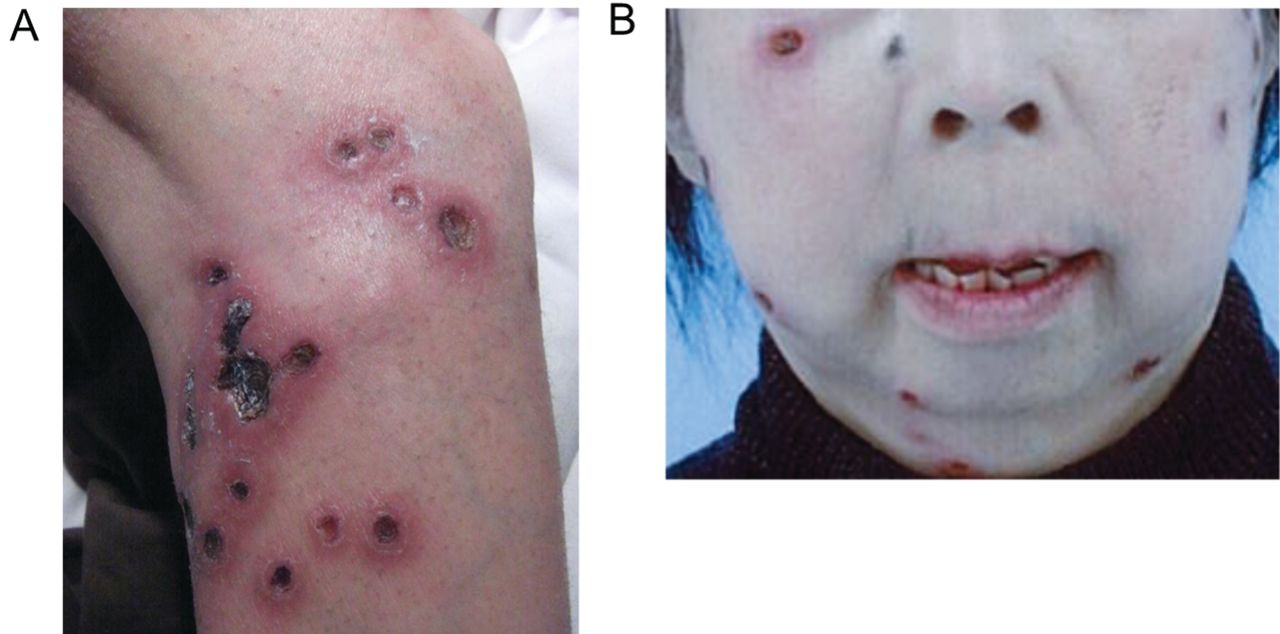
Figure 2.
  • Download figure
  • Open in new tab
  • Download powerpoint
Figure 2.

Two representative cases with skin manifestations of EBV-positive mucocutaneous ulcer (EBVMCU). Typical skin manifestations of EBVMCU (A: case 5, B: case 2) are shown. Characteristic sharply demarcated skin ulcers with an erythematous appearance accompanied by crusting and necrosis can be seen.

HLA typing of patients with MTX-LPD

As shown in Table 2, we found that 3 cases out of 16 were heterozygous for the HLA-B15:11 allele. The allele frequency of HLA-B15:11 was higher in EBV+ RA with MTX-LPD, compared with the control JHD group and that of the Japanese RA cohort (Pc = 0.0079 and 0.024, respectively, Table 3). RA-shared epitopes were observed in 11 of 16 cases (69%), a significantly higher proportion than in healthy Japanese controls (38%, n = 1508; p = 0.018), but not in Japanese patients with RA (n = 759)9.

View this table:
  • View inline
  • View popup
Table 2.

HLA-A, B, and DR alleles of 16 cases of RA with MTX-LPD.

View this table:
  • View inline
  • View popup
Table 3.

Risk allele of RA with MTX-LPD in Japanese population.

Clinical course of patients with MTX-LPD

MTX was withdrawn in all cases at the time of LPD diagnosis. When examining the need for chemotherapy within 18 months of diagnosis, withdrawal of MTX alone was more successful for those in the EBVMCU group (n = 4, cases 1, 4, 5, and 21) than the other cases (n = 13; 75% vs 7.7%, p = 0.015; Figure 3). Because the observation periods were at most 2 years in the majority of cases, we were unable to calculate longterm prognosis. Five patients (cases 2, 7, 8, 9, and 12) died; LPD recurred in 2 patients at 90 months (case 9) and 21 months (case 12) from the original diagnosis and did not respond to continued chemotherapy. One patient (case 2) died from intercurrent myelitis and sepsis soon after the diagnosis of LPD and 1 patient (case 7) died from bleomycin-induced pneumonia.
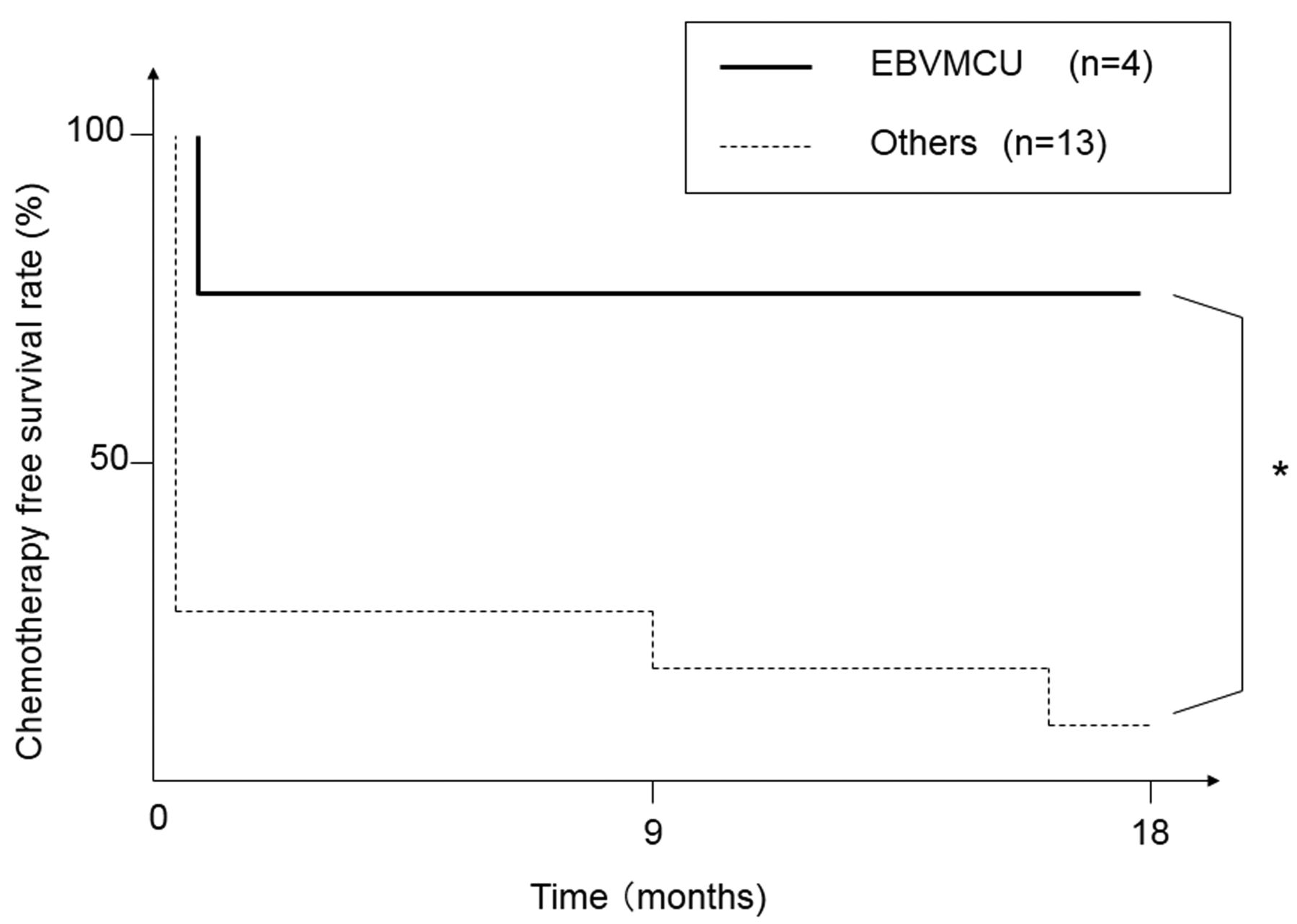
Figure 3.
  • Download figure
  • Open in new tab
  • Download powerpoint
Figure 3.

Chemotherapy-free survival. Kaplan-Meier curve shows chemotherapy-free survival within 18 months, comparing patients in the EBV-positive mucocutaneous ulcer (EBVMCU) group with those with other forms of MTX-LPD. Methotrexate was withdrawn in all cases. *Log-rank test, p < 0.05. MTX-LPD: methotrexate-associated lymphoproliferative disorders; EBV: Epstein-Barr virus.

One patient (case 8) was first diagnosed with EBV-positive small B cell lymphoma (SBL). Although chemotherapy resulted in partial remission, she had an indolent clinical course without chemotherapy until the tumor progressed and histopathological study revealed EBV-negative DLBCL with the same phenotype as the SBL. A clonal relationship between the 2 lymphomas was not proven; however, Richter syndrome was suspected clinically. With regard to the predicted unfavorable prognosis, she was treated with autologous peripheral blood stem cell transplantation, but she died of pneumocystis pneumonia under continuous immunosuppression. Although 2 cases of EBVMCU (cases 2 and 5) were included in Ann Arbor stage IV, each had a favorable clinical outcome.

DISCUSSION

We have shown that the presence of EBVMCU appears to confer a better prognosis in patients with MTX-LPD. Most of our patients with positive outcomes had been diagnosed with EBVMCU. Of the 12 cases of MTX-LPD with mucocutaneous ulcer reported in the literature7,10,11,12,13,14,15,16,17 all except 117 were EBV-positive and all 9 cases with available data showed complete remission without chemotherapy.

EBVMCU was first reported to be a favorable prognostic indicator in a case series of 26 patients (consisting of 19 with Age-LPD and 7 with iatrogenic immunodeficiency-associated LPD including 4 with MTX-LPD)7, but the incidence of EBVMCU in MTX-LPD was not known. Our study shows that the incidence of EBVMCU in EBV+ MTX-LPD is 42% (5 out of 12), which is higher than that of EBVMCU in Age-LPD (13%, 16 cases out of 122)18.

Age-LPD is believed to be a consequence of an underlying immunological deficit, or immunosenescence of the T cell receptor (TCR) repertoire19,20 — a natural degeneration of the immune system that occurs with aging. Considering the high average age of our cases, age-related immunosenescence might be partly involved in the development of MTX-LPD. This may be revealed by decreases in the TCR repertoire in the future.

Only a few cases of EBV latency in MTX-LPD have been reported; those of EBV latency among MTX-LPD, PT-LPD, and Age-LPD are summarized in Table 421,22,23. Other case series include 53 cases of LPD in a variety of autoimmune diseases, including 4 cases of MTX-LPD, in which all 16 cases of EBV+ LPD were in latency II24. Taken together, these data suggest that EBV+ MTX-LPD is more likely to be in latency II, followed by latency III. This observation also appears to hold true for PT-LPD and Age-LPD. PT-LPD has been generally categorized as latency III25, but is often seen to be in latency II. Cases of Age-LPD were also found to be mainly in latency II. Nonetheless, the latency classification had no value in predicting the prognosis of MTX-LPD in our cohort. The utility of EBV latency in MTX-LPD remains unknown.

View this table:
  • View inline
  • View popup
Table 4.

EBV latency classification among MTX-LPD, PT-LPD, and Age-LPD.

Although the pathogenesis of EBVMCU is unclear, lymphocytic vasculitis was observed in more than half our cases of EBVMCU. In EBV-positive LPD, the Mig monokine, induced by interferon-γ (IFN-γ), and IFN-γ inducible protein-10 (mainly produced by reactive cells including endothelial cells) are thought to be powerful instigators of vascular and tissue injuries26. Thus, we hypothesize that tissue necrosis and the impairment of local blood flow to the area of vascular damage might be pivotal to the pathogenesis of EBVMCU. Although it is unclear why patients with MTX-LPD who developed EBVMCU had a better prognosis, several factors might be responsible. One possibility is that the mucocutaneous ulcer is so conspicuous that patients seek medical help more promptly, when diagnosis is relatively straightforward and the disease is in an earlier, potentially reversible stage. Thus, the prompt cessation of MTX may lead to a good outcome.

Our study is the first, to our knowledge, to have conducted HLA typing, revealing that HLA-B15:11 could be a risk allele in EBV+ RA with MTX-LPD. Notably, all 3 HLA-B15:11-positive cases were EBV-positive and 2 were polymorphic, indicating that this allele may be linked to the susceptibility to EBV infection and development of LPD. In our study, HLA-B15:11 had no correlation with HLA-shared epitopes, RF, or ACPA. To the best of our knowledge, there have been no reports of any relationship between this allele and other diseases. The identification of a genetic risk factor could help to clarify the pathogenesis of LPD and to achieve safer therapy for patients who might be at risk of LPD if their RA is treated with MTX. Because this is a retrospective study, there are some limitations, and a larger scale prospective trial is needed to clarify the pathogenesis of this disease.

We have demonstrated that cases of EBVMCU, a subgroup of MTX-LPD, were all histologically polymorphic and had a more favorable outcome by withdrawing MTX alone. In addition, we found that the frequency of the HLA-B15:11 allele was significantly increased in our cohort, which suggests that it may be a risk factor for EBV+ RA with MTX-LPD.

Acknowledgment

The authors thank Dr. Toda (Kyoto University, Center for Anatomical Studies) for performing immunostaining studies and Dr. Inoko (Tokai University, Department of Molecular Science) for kindly providing the HLA reference data of Japanese patients with rheumatoid arthritis.

  • Accepted for publication October 8, 2013.

REFERENCES

  1. 1.↵
    1. Gaulard P,
    2. Swerdlow SH,
    3. Harris NL,
    4. Jaffe ES,
    5. Sundstrom C
    . Other iatrogenic immunodeficiency-associated lymphoproliferative disorders. In: Swerdlow SH, Campo E, Harris NL, Jaffe ES, Pileri SA, Stein H, et al., eds. Tumours of haematopoietic and lymphoid tissues. Pathology & genetics. World Health Organization classification of tumours. 4th ed. Lyon: IARC Press; 2008:350–1.
  2. 2.↵
    1. Weinblatt ME,
    2. Coblyn JS,
    3. Fox DA,
    4. Fraser PA,
    5. Holdsworth DE,
    6. Glass DN,
    7. et al.
    Efficacy of low-dose methotrexate in rheumatoid arthritis. N Engl J Med 1985;312:818–22.
    OpenUrlCrossRefPubMed
  3. 3.↵
    1. Rath T,
    2. Rubbert A
    . Drug combinations with methotrexate to treat rheumatoid arthritis. Clin Exp Rheumatol 2010;5 Suppl 61:S52–7.
    OpenUrl
  4. 4.↵
    1. Harris NL,
    2. Swerdlow SH
    . Methotrexate-associated lymphoproliferative disorders. In: Jaffe ES, Harris NL, Stein H, Vardiman JW, eds. Tumours of haematopoietic and lymphoid tissues. Pathology & genetics. World Health Organization classification of tumours. 3rd ed. Lyon: IARC Press; 2001:270–1.
  5. 5.↵
    1. Feng WH,
    2. Cohen JI,
    3. Fischer S,
    4. Li L,
    5. Sneller M,
    6. Goldbach-Mansky R,
    7. et al.
    Reactivation of latent Epstein-Barr virus by methotrexate: a potential contributor to methotrexate-associated lymphomas. J Natl Cancer Inst 2004;96:1691–702.
    OpenUrlAbstract/FREE Full Text
  6. 6.↵
    1. Young LS,
    2. Rickinson AB
    . Epstein-Barr virus: 40 years on. Nat Rev Cancer 2004;4:757–68.
    OpenUrlCrossRefPubMed
  7. 7.↵
    1. Dojcinov SD,
    2. Venkataraman G,
    3. Raffeld M,
    4. Pittaluga S,
    5. Jaffe ES
    . EBV positive mucocutaneous ulcer—a study of 26 cases associated with various sources of immunosuppression. Am J Surg Pathol 2010;34:405–17.
    OpenUrlCrossRefPubMed
  8. 8.↵
    1. Oyama T,
    2. Ichimura K,
    3. Suzuki R,
    4. Suzumiya J,
    5. Ohshima K,
    6. Yatabe Y,
    7. et al.
    Senile EBV+ B-cell lymphoproliferative disorders: a clinicopathologic study of 22 patients. Am J Surg Pathol 2003;27:16–26.
    OpenUrlCrossRefPubMed
  9. 9.↵
    1. Ohmura K,
    2. Terao C,
    3. Maruya E,
    4. Katayama M,
    5. Matoba K,
    6. Shimada K,
    7. et al.
    Anti-citrullinated peptide antibody-negative RA is a genetically distinct subset: a definitive study using only bone-erosive ACPA-negative rheumatoid arthritis. Rheumatology 2010;49:2298–304.
    OpenUrlAbstract/FREE Full Text
  10. 10.↵
    1. Hashizume H,
    2. Uchiyama I,
    3. Kawamura T,
    4. Suda T,
    5. Takigawa M,
    6. Tokura Y
    . Epstein-Barr virus-positive mucocutaneous ulcers as a manifestation of methotrexate-associated B-cell lymphoproliferative disorders. Acta Derm Venereol 2012;92:276–7.
    OpenUrlCrossRefPubMed
  11. 11.↵
    1. Curry JL,
    2. Prieto VG,
    3. Jones DM,
    4. Vega F,
    5. Duvic M,
    6. Diwan AH
    . Transient iatrogenic immunodeficiency-related B-cell lymphoproliferative disorder of the skin in a patient with mycosis fungoides/Sezary syndrome. J Cutan Pathol 2011;38:295–7.
    OpenUrlCrossRefPubMed
  12. 12.↵
    1. Shimura C,
    2. Satoh T,
    3. Takayama K,
    4. Yokozeki H
    . Methotrexate-related lymphoproliferative disorder with extensive vascular involvement in a patient with rheumatoid arthritis. J Am Acad Dermatol 2009;61:126–9.
    OpenUrlCrossRefPubMed
  13. 13.↵
    1. Pastor-Nieto MA,
    2. Kilmurray LG,
    3. Lopez-Chumillas A,
    4. O’Valle F,
    5. Garcia-Del Moral R,
    6. Puig AM,
    7. et al.
    Methotrexate-associated lymphoproliferative disorder presenting as oral ulcers in a patient with rheumatoid arthritis [in Spanish]. Actas Dermosifiliogr 2009;100:142–6.
    OpenUrlCrossRefPubMed
  14. 14.↵
    1. Uneda S,
    2. Sonoki T,
    3. Nakamura Y,
    4. Matsuoka H,
    5. Nakakuma H
    . Rapid vanishing of tumors by withdrawal of methotrexate in Epstein-Barr virus-related B cell lymphoproliferative disorder. Intern Med 2008;47:1445–6.
    OpenUrlCrossRefPubMed
  15. 15.↵
    1. Tanaka A,
    2. Shigematsu H,
    3. Kojima M,
    4. Sakashita H,
    5. Kusama K
    . Methotrexate-associated lymphoproliferative disorder arising in a patient with adult Still’s disease. J Oral Maxillofac Surg 2008;66:1492–5.
    OpenUrlCrossRefPubMed
  16. 16.↵
    1. Maruani A,
    2. Wierzbicka E,
    3. Machet MC,
    4. Abdallah-Lotf M,
    5. de Muret A,
    6. Machet L
    . Reversal of multifocal cutaneous lymphoproliferative disease associated with Epstein-Barr virus after withdrawal of methotrexate therapy for rheumatoid arthritis. J Am Acad Dermatol 2007;5 Suppl:S69–71.
    OpenUrl
  17. 17.↵
    1. Clarke LE,
    2. Junkins-Hopkins J,
    3. Seykora JT,
    4. Adler DJ,
    5. Elenitsas R
    . Methotrexate-associated lymphoproliferative disorder in a patient with rheumatoid arthritis presenting in the skin. J Am Acad Dermatol 2007;56:686–90.
    OpenUrlCrossRefPubMed
  18. 18.↵
    1. Dojcinov SD,
    2. Venkataraman G,
    3. Pittaluga S,
    4. Wlodarska I,
    5. Schrager JA,
    6. Raffeld M,
    7. et al.
    Age-related EBV-associated lymphoproliferative disorders in the Western population: a spectrum of reactive lymphoid hyperplasia and lymphoma. Blood 2011;117:4726–35.
    OpenUrlAbstract/FREE Full Text
  19. 19.↵
    1. Oyama T,
    2. Yamamoto K,
    3. Asano N,
    4. Oshiro A,
    5. Suzuki R,
    6. Kagami Y,
    7. et al.
    Age-related EBV-associated B-cell lymphoproliferative disorders constitute a distinct clinicopathologic group: a study of 96 patients. Clin Cancer Res 2007;13:5124–32.
    OpenUrlAbstract/FREE Full Text
  20. 20.↵
    1. Shimoyama Y,
    2. Yamamoto K,
    3. Asano N,
    4. Oyama T,
    5. Kinoshita T,
    6. Nakamura S
    . Age-related Epstein-Barr virus-associated B-cell lymphoproliferative disorders: special references to lymphomas surrounding this newly recognized clinicopathologic disease. Cancer Sci 2008;99:1085–91.
    OpenUrlCrossRefPubMed
  21. 21.↵
    1. Miyazaki T,
    2. Fujimaki K,
    3. Shirasugi Y,
    4. Yoshiba F,
    5. Ohsaka M,
    6. Miyazaki K,
    7. et al.
    Remission of lymphoma after withdrawal of methotrexate in rheumatoid arthritis: relationship with type of latent Epstein-Barr virus infection. Am J Hematol 2007;82:1106–9.
    OpenUrlCrossRefPubMed
  22. 22.↵
    1. Birkeland SA,
    2. Hamilton-Dutoit S
    . Is posttransplant lymphoproliferative disorder (PTLD) caused by any specific immunosuppressive drug or by the transplantation per se? Transplantation 2003;76:984–8.
    OpenUrlCrossRefPubMed
  23. 23.↵
    1. Asano N,
    2. Yamamoto K,
    3. Tamaru J,
    4. Oyama T,
    5. Ishida F,
    6. Ohshima K,
    7. et al.
    Age-related Epstein-Barr virus (EBV)-associated B-cell lymphoproliferative disorders: comparison with EBV-positive classic Hodgkin lymphoma in elderly patients. Blood 2009;113:2629–36.
    OpenUrlAbstract/FREE Full Text
  24. 24.↵
    1. Hoshida Y,
    2. Tomita Y,
    3. Zhiming D,
    4. Yamauchi A,
    5. Nakatsuka S,
    6. Kurasono Y,
    7. et al.
    Lymphoproliferative disorders in autoimmune diseases in Japan: analysis of clinicopathological features and Epstein-Barr virus infection. Int J Cancer 2004;108:443–9.
    OpenUrlCrossRefPubMed
  25. 25.↵
    1. Masucci MG
    . Epstein-Barr virus oncogenesis and the ubiquitin-proteasome system. Oncogene 2004;23:2107–15.
    OpenUrlCrossRefPubMed
  26. 26.↵
    1. Teruya-Feldstein J,
    2. Jaffe ES,
    3. Burd PR,
    4. Kanegane H,
    5. Kingma DW,
    6. Wilson WH,
    7. et al.
    The role of Mig, the monokine induced by interferon-gamma, and IP-10, the interferon-gamma-inducible protein-10, in tissue necrosis and vascular damage associated with Epstein-Barr virus-positive lymphoproliferative disease. Blood 1997;90:4099–105.
    OpenUrlAbstract/FREE Full Text
View Abstract
PreviousNext
Back to top

In this issue

The Journal of Rheumatology
Vol. 41, Issue 2
1 Feb 2014
  • Table of Contents
  • Table of Contents (PDF)
  • Index by Author
  • Editorial Board (PDF)
Print
Download PDF
Article Alerts
Sign In to Email Alerts with your Email Address
Email Article

Thank you for your interest in spreading the word about The Journal of Rheumatology.

NOTE: We only request your email address so that the person you are recommending the page to knows that you wanted them to see it, and that it is not junk mail. We do not capture any email address.

Enter multiple addresses on separate lines or separate them with commas.
A Clinical, Pathological, and Genetic Characterization of Methotrexate-associated Lymphoproliferative Disorders
(Your Name) has forwarded a page to you from The Journal of Rheumatology
(Your Name) thought you would like to see this page from the The Journal of Rheumatology web site.
CAPTCHA
This question is for testing whether or not you are a human visitor and to prevent automated spam submissions.
Citation Tools
A Clinical, Pathological, and Genetic Characterization of Methotrexate-associated Lymphoproliferative Disorders
Noriyuki Yamakawa, Masakazu Fujimoto, Daisuke Kawabata, Chikashi Terao, Momoko Nishikori, Ran Nakashima, Yoshitaka Imura, Naoichiro Yukawa, Hajime Yoshifuji, Koichiro Ohmura, Takao Fujii, Toshiyuki Kitano, Tadakazu Kondo, Kimiko Yurugi, Yasuo Miura, Taira Maekawa, Hiroh Saji, Akifumi Takaori-Kondo, Fumihiko Matsuda, Hironori Haga, Tsuneyo Mimori
The Journal of Rheumatology Feb 2014, 41 (2) 293-299; DOI: 10.3899/jrheum.130270

Citation Manager Formats

  • BibTeX
  • Bookends
  • EasyBib
  • EndNote (tagged)
  • EndNote 8 (xml)
  • Medlars
  • Mendeley
  • Papers
  • RefWorks Tagged
  • Ref Manager
  • RIS
  • Zotero

 Request Permissions

Share
A Clinical, Pathological, and Genetic Characterization of Methotrexate-associated Lymphoproliferative Disorders
Noriyuki Yamakawa, Masakazu Fujimoto, Daisuke Kawabata, Chikashi Terao, Momoko Nishikori, Ran Nakashima, Yoshitaka Imura, Naoichiro Yukawa, Hajime Yoshifuji, Koichiro Ohmura, Takao Fujii, Toshiyuki Kitano, Tadakazu Kondo, Kimiko Yurugi, Yasuo Miura, Taira Maekawa, Hiroh Saji, Akifumi Takaori-Kondo, Fumihiko Matsuda, Hironori Haga, Tsuneyo Mimori
The Journal of Rheumatology Feb 2014, 41 (2) 293-299; DOI: 10.3899/jrheum.130270
del.icio.us logo Twitter logo Facebook logo  logo Mendeley logo
  • Tweet Widget
  •  logo
Bookmark this article

Jump to section

  • Article
    • Abstract
    • MATERIALS AND METHODS
    • RESULTS
    • DISCUSSION
    • Acknowledgment
    • REFERENCES
  • Figures & Data
  • Info & Metrics
  • References
  • PDF

Keywords

RHEUMATIC DISEASES
RHEUMATOID ARTHRITIS
SKIN MANIFESTATIONS
HLA ANTIGENS
HEMATOPOIETIC SYSTEM

Related Articles

Cited By...

More in this TOC Section

  • The Effect of Everyday Discrimination on Systemic Lupus Erythematosus Disease Activity and Mental Health Outcomes
  • Evaluating Hip Osteoarthritis as a Risk Factor for Immune Checkpoint Inhibitor–Induced Inflammatory Arthritis
  • Clinical and Epidemiological Features of Juvenile-Onset Systemic Sclerosis From a Nationwide Survey in Japan
Show more Article

Similar Articles

Keywords

  • rheumatic diseases
  • rheumatoid arthritis
  • SKIN MANIFESTATIONS
  • HLA ANTIGENS
  • HEMATOPOIETIC SYSTEM

Content

  • First Release
  • Current
  • Archives
  • Collections
  • Audiovisual Rheum
  • COVID-19 and Rheumatology

Resources

  • Guide for Authors
  • Submit Manuscript
  • Author Payment
  • Reviewers
  • Advertisers
  • Classified Ads
  • Reprints and Translations
  • Permissions
  • Meetings
  • FAQ
  • Policies

Subscribers

  • Subscription Information
  • Purchase Subscription
  • Your Account
  • Terms and Conditions

More

  • About Us
  • Contact Us
  • My Alerts
  • My Folders
  • Privacy/GDPR Policy
  • RSS Feeds
The Journal of Rheumatology
The content of this site is intended for health care professionals.
Copyright © 2025 by The Journal of Rheumatology Publishing Co. Ltd.
Print ISSN: 0315-162X; Online ISSN: 1499-2752
Powered by HighWire