
Main menu

  • Home
  • Content
    • First Release
    • Current
    • Archives
    • Collections
    • Audiovisual Rheum
    • 50th Volume Reprints
  • Resources
    • Guide for Authors
    • Submit Manuscript
    • Payment
    • Reviewers
    • Advertisers
    • Classified Ads
    • Reprints and Translations
    • Permissions
    • Meetings
    • FAQ
    • Policies
  • Subscribers
    • Subscription Information
    • Purchase Subscription
    • Your Account
    • Terms and Conditions
  • About Us
    • About Us
    • Editorial Board
    • Letter from the Editor
    • Duncan A. Gordon Award
    • Privacy/GDPR Policy
    • Accessibility
  • Contact Us
  • JRheum Supplements
  • Services

User menu

  • My Cart
  • Log In

Search

  • Advanced search
The Journal of Rheumatology
  • JRheum Supplements
  • Services
  • My Cart
  • Log In
The Journal of Rheumatology

Advanced Search

  • Home
  • Content
    • First Release
    • Current
    • Archives
    • Collections
    • Audiovisual Rheum
    • 50th Volume Reprints
  • Resources
    • Guide for Authors
    • Submit Manuscript
    • Payment
    • Reviewers
    • Advertisers
    • Classified Ads
    • Reprints and Translations
    • Permissions
    • Meetings
    • FAQ
    • Policies
  • Subscribers
    • Subscription Information
    • Purchase Subscription
    • Your Account
    • Terms and Conditions
  • About Us
    • About Us
    • Editorial Board
    • Letter from the Editor
    • Duncan A. Gordon Award
    • Privacy/GDPR Policy
    • Accessibility
  • Contact Us
  • Follow Jrheum on BlueSky
  • Follow jrheum on Twitter
  • Visit jrheum on Facebook
  • Follow jrheum on LinkedIn
  • Follow jrheum on YouTube
  • Follow jrheum on Instagram
  • Follow jrheum on RSS
Research ArticleOMERACT 11

Item Response Theory, Computerized Adaptive Testing, and PROMIS: Assessment of Physical Function

James F. Fries, James Witter, Matthias Rose, David Cella, Dinesh Khanna and Esi Morgan-DeWitt
The Journal of Rheumatology January 2014, 41 (1) 153-158; DOI: https://doi.org/10.3899/jrheum.130813
James F. Fries
From the Department of Medicine, Stanford University School of Medicine, Stanford, California; National Institutes of Arthritis and Musculoskeletal and Skin Diseases (NIAMS), Bethesda, Maryland, USA; Medical School Charité, University Medicine Berlin, Berlin, Germany; Department of Medical Social Sciences, Feinberg School of Medicine, Northwestern University, Chicago, Illinois; Department of Medicine, University of Michigan School of Medicine, Ann Arbor, Michigan; Department of Pediatrics, University of Cincinnati School of Medicine, Cincinnati, Ohio, USA.
  • Find this author on Google Scholar
  • Find this author on PubMed
  • Search for this author on this site
James Witter
  • Find this author on Google Scholar
  • Find this author on PubMed
  • Search for this author on this site
Matthias Rose
  • Find this author on Google Scholar
  • Find this author on PubMed
  • Search for this author on this site
David Cella
  • Find this author on Google Scholar
  • Find this author on PubMed
  • Search for this author on this site
  • For correspondence: d-cella{at}northwestern.edu
Dinesh Khanna
  • Find this author on Google Scholar
  • Find this author on PubMed
  • Search for this author on this site
Esi Morgan-DeWitt
  • Find this author on Google Scholar
  • Find this author on PubMed
  • Search for this author on this site
  • Article
  • Figures & Data
  • Info & Metrics
  • References
  • PDF
PreviousNext
Loading

Article Figures & Data

Figures

  • Figure 1.
    • Download figure
    • Open in new tab
    • Download powerpoint
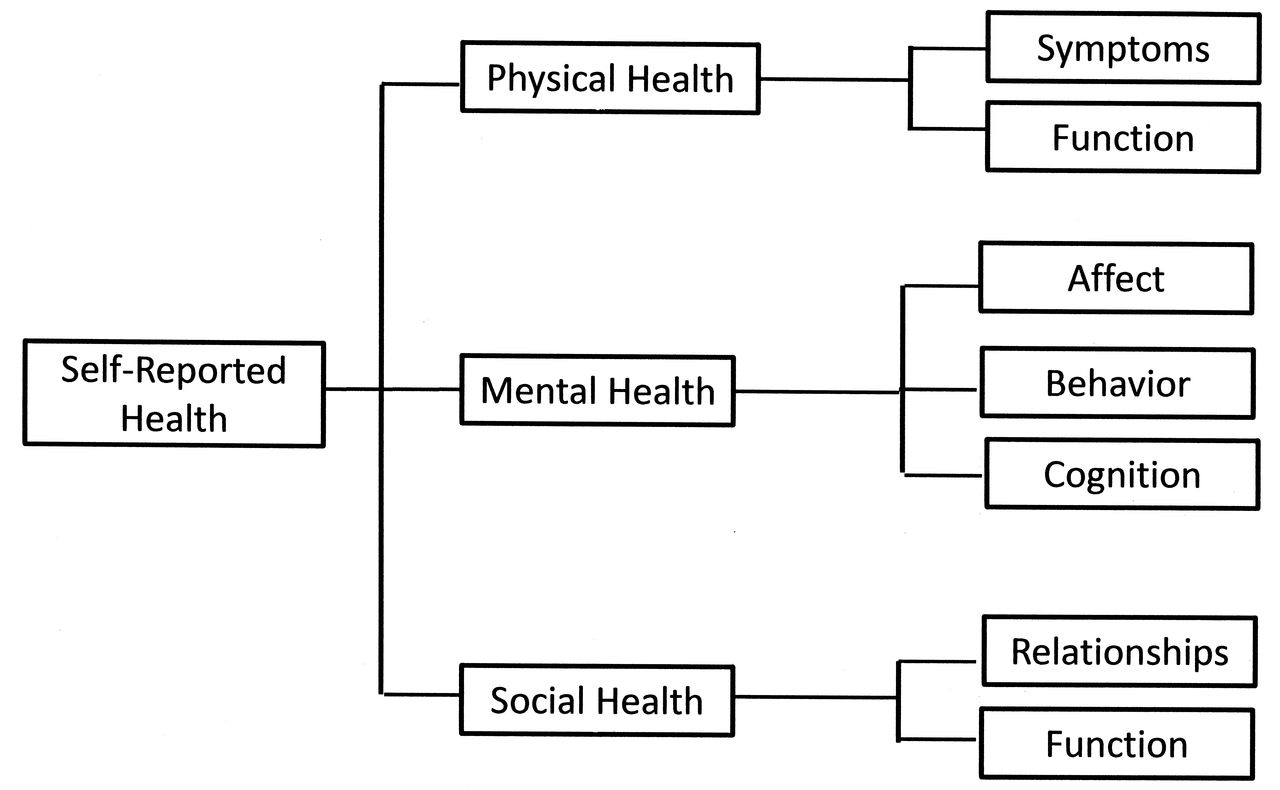
    Figure 1.

    The PROMIS hierarchy of domains. A simplified diagram of the first 3 levels of the hierarchy. Patient-reported Outcomes Measurement Information System (PROMIS®) domain framework16. © 2011 PROMIS Health Organization and PROMIS Cooperative Group. Adapted with permission.

  • APPENDIX 1.
    • Download figure
    • Open in new tab
    • Download powerpoint
    APPENDIX 1.

    Comparison of information content between 6 instruments. The most precise instruments have curves that are below and broader than the less-reliable instruments. Reliability at the “floor” is represented by the left side of the curves and reliability at the “ceiling” is represented by the right side of the curves. The 10-item PROMIS CAT covers 6.4 population SD and has much greater precision in normal populations (less ceiling effect). Reprinted from Fries, et al. J Rheumatol 2009;36:2061–6. PROMIS: Patient-reported Outcomes Measurement Information System; HAQ: Health Assessment Questionnaire; PF: physical function (domain); CAT: computerized adaptive testing.
PreviousNext
Back to top

In this issue

The Journal of Rheumatology
Vol. 41, Issue 1
1 Jan 2014
  • Table of Contents
  • Table of Contents (PDF)
  • Index by Author
  • Editorial Board (PDF)
Print
Download PDF
Article Alerts
Sign In to Email Alerts with your Email Address
Email Article

Thank you for your interest in spreading the word about The Journal of Rheumatology.

NOTE: We only request your email address so that the person you are recommending the page to knows that you wanted them to see it, and that it is not junk mail. We do not capture any email address.

Enter multiple addresses on separate lines or separate them with commas.
Item Response Theory, Computerized Adaptive Testing, and PROMIS: Assessment of Physical Function
(Your Name) has forwarded a page to you from The Journal of Rheumatology
(Your Name) thought you would like to see this page from the The Journal of Rheumatology web site.
CAPTCHA
This question is for testing whether or not you are a human visitor and to prevent automated spam submissions.
Citation Tools
Item Response Theory, Computerized Adaptive Testing, and PROMIS: Assessment of Physical Function
James F. Fries, James Witter, Matthias Rose, David Cella, Dinesh Khanna, Esi Morgan-DeWitt
The Journal of Rheumatology Jan 2014, 41 (1) 153-158; DOI: 10.3899/jrheum.130813

Citation Manager Formats

  • BibTeX
  • Bookends
  • EasyBib
  • EndNote (tagged)
  • EndNote 8 (xml)
  • Medlars
  • Mendeley
  • Papers
  • RefWorks Tagged
  • Ref Manager
  • RIS
  • Zotero

 Request Permissions

Share
Item Response Theory, Computerized Adaptive Testing, and PROMIS: Assessment of Physical Function
James F. Fries, James Witter, Matthias Rose, David Cella, Dinesh Khanna, Esi Morgan-DeWitt
The Journal of Rheumatology Jan 2014, 41 (1) 153-158; DOI: 10.3899/jrheum.130813
del.icio.us logo Twitter logo Facebook logo  logo Mendeley logo
  • Tweet Widget
  •  logo
Bookmark this article

Jump to section

  • Article
    • Abstract
    • MATERIALS AND METHODS
    • RESULTS
    • DISCUSSION
    • Appendix
    • Footnotes
    • REFERENCES
  • Figures & Data
  • Info & Metrics
  • References
  • PDF

Keywords

ITEM RESPONSE THEORY
COMPUTERIZED ADAPTIVE TESTING
PROMIS
PHYSICAL FUNCTION
DISABILITY

Related Articles

Cited By...

More in this TOC Section

OMERACT 11

  • Updating the OMERACT Filter: Implications for Patient-reported Outcomes
  • Updating the OMERACT Filter: Discrimination and Feasibility
  • Can We Decide Which Outcomes Should Be Measured in Every Clinical Trial? A Scoping Review of the Existing Conceptual Frameworks and Processes to Develop Core Outcome Sets
Show more OMERACT 11

Methods

  • What Has Been the Effect on Trial Outcome Assessments of a Decade of Patient Participation in OMERACT?
  • Including Health Equity Considerations in Development of Instruments for Rheumatology Research: An Introduction to a Novel OMERACT Paradigm
Show more Methods

Similar Articles

Keywords

  • ITEM RESPONSE THEORY
  • COMPUTERIZED ADAPTIVE TESTING
  • PROMIS
  • PHYSICAL FUNCTION
  • DISABILITY

Content

  • First Release
  • Current
  • Archives
  • Collections
  • Audiovisual Rheum
  • COVID-19 and Rheumatology

Resources

  • Guide for Authors
  • Submit Manuscript
  • Author Payment
  • Reviewers
  • Advertisers
  • Classified Ads
  • Reprints and Translations
  • Permissions
  • Meetings
  • FAQ
  • Policies

Subscribers

  • Subscription Information
  • Purchase Subscription
  • Your Account
  • Terms and Conditions

More

  • About Us
  • Contact Us
  • My Alerts
  • My Folders
  • Privacy/GDPR Policy
  • RSS Feeds
The Journal of Rheumatology
The content of this site is intended for health care professionals.
Copyright © 2025 by The Journal of Rheumatology Publishing Co. Ltd.
Print ISSN: 0315-162X; Online ISSN: 1499-2752
Powered by HighWire