Main menu

  • Home
  • Content
    • First Release
    • Current
    • Archives
    • Collections
    • Audiovisual Rheum
    • 50th Volume Reprints
  • Resources
    • Guide for Authors
    • Submit Manuscript
    • Payment
    • Reviewers
    • Advertisers
    • Classified Ads
    • Reprints and Translations
    • Permissions
    • Meetings
    • FAQ
    • Policies
  • Subscribers
    • Subscription Information
    • Purchase Subscription
    • Your Account
    • Terms and Conditions
  • About Us
    • About Us
    • Editorial Board
    • Letter from the Editor
    • Duncan A. Gordon Award
    • Privacy/GDPR Policy
    • Accessibility
  • Contact Us
  • JRheum Supplements
  • Services

User menu

  • My Cart
  • Log In

Search

  • Advanced search
The Journal of Rheumatology
  • JRheum Supplements
  • Services
  • My Cart
  • Log In
The Journal of Rheumatology

Advanced Search

  • Home
  • Content
    • First Release
    • Current
    • Archives
    • Collections
    • Audiovisual Rheum
    • 50th Volume Reprints
  • Resources
    • Guide for Authors
    • Submit Manuscript
    • Payment
    • Reviewers
    • Advertisers
    • Classified Ads
    • Reprints and Translations
    • Permissions
    • Meetings
    • FAQ
    • Policies
  • Subscribers
    • Subscription Information
    • Purchase Subscription
    • Your Account
    • Terms and Conditions
  • About Us
    • About Us
    • Editorial Board
    • Letter from the Editor
    • Duncan A. Gordon Award
    • Privacy/GDPR Policy
    • Accessibility
  • Contact Us
  • Follow Jrheum on BlueSky
  • Follow jrheum on Twitter
  • Visit jrheum on Facebook
  • Follow jrheum on LinkedIn
  • Follow jrheum on YouTube
  • Follow jrheum on Instagram
  • Follow jrheum on RSS
LetterLetter

Higher-dose Anakinra Is Effective in a Case of Medically Refractory Macrophage Activation Syndrome

PHILIP J. KAHN and RANDY Q. CRON
The Journal of Rheumatology May 2013, 40 (5) 743-744; DOI: https://doi.org/10.3899/jrheum.121098
PHILIP J. KAHN
New York University School of Medicine, Pediatrics, New York, New York;
MD
  • Find this author on Google Scholar
  • Find this author on PubMed
  • Search for this author on this site
RANDY Q. CRON
MD, PhD
  • Find this author on Google Scholar
  • Find this author on PubMed
  • Search for this author on this site
  • For correspondence: rcron{at}peds.uab.edu
  • Article
  • Figures & Data
  • Info & Metrics
  • References
  • PDF
PreviousNext
Loading

To the Editor:

An 11-year-old girl was diagnosed with systemic juvenile idiopathic arthritis (sJIA) after presenting with prolonged fever, lymphadenopathy, arthritis, classic sJIA rash, and hyperferritinemia. Complicating macrophage activation syndrome (MAS) was diagnosed, noting hemophagocytosis on bone marrow biopsy for further evaluation of mental status changes. Despite high-dose glucocorticoids and cyclosporine, she remained febrile until the addition of daily subcutaneous interleukin 1 (IL-1) receptor antagonist anakinra (100 mg).

She later developed a methicillin-resistant Staphylococcus aureus abscess, and anakinra was withheld. After several days of intravenous antibiotics, she was discharged while taking oral antibiotics, prednisone, and cyclosporine. After anakinra had been withheld for 14 days, she was rehospitalized, this time for a flare of her sJIA, with fever, hypotension, and doubling of her ferritin level (9000 ng/ml). Daily anakinra was resumed, and she received solumedrol pulse therapy and intravenous cyclosporine for persistent fever and hyperferritinemia (peaking at 100,000 ng/ml). She was eventually discharged while taking cyclosporine, prednisone, and anakinra. She remained clinically quiescent for several weeks without fever and her serum ferritin decreased (300 ng/ml).

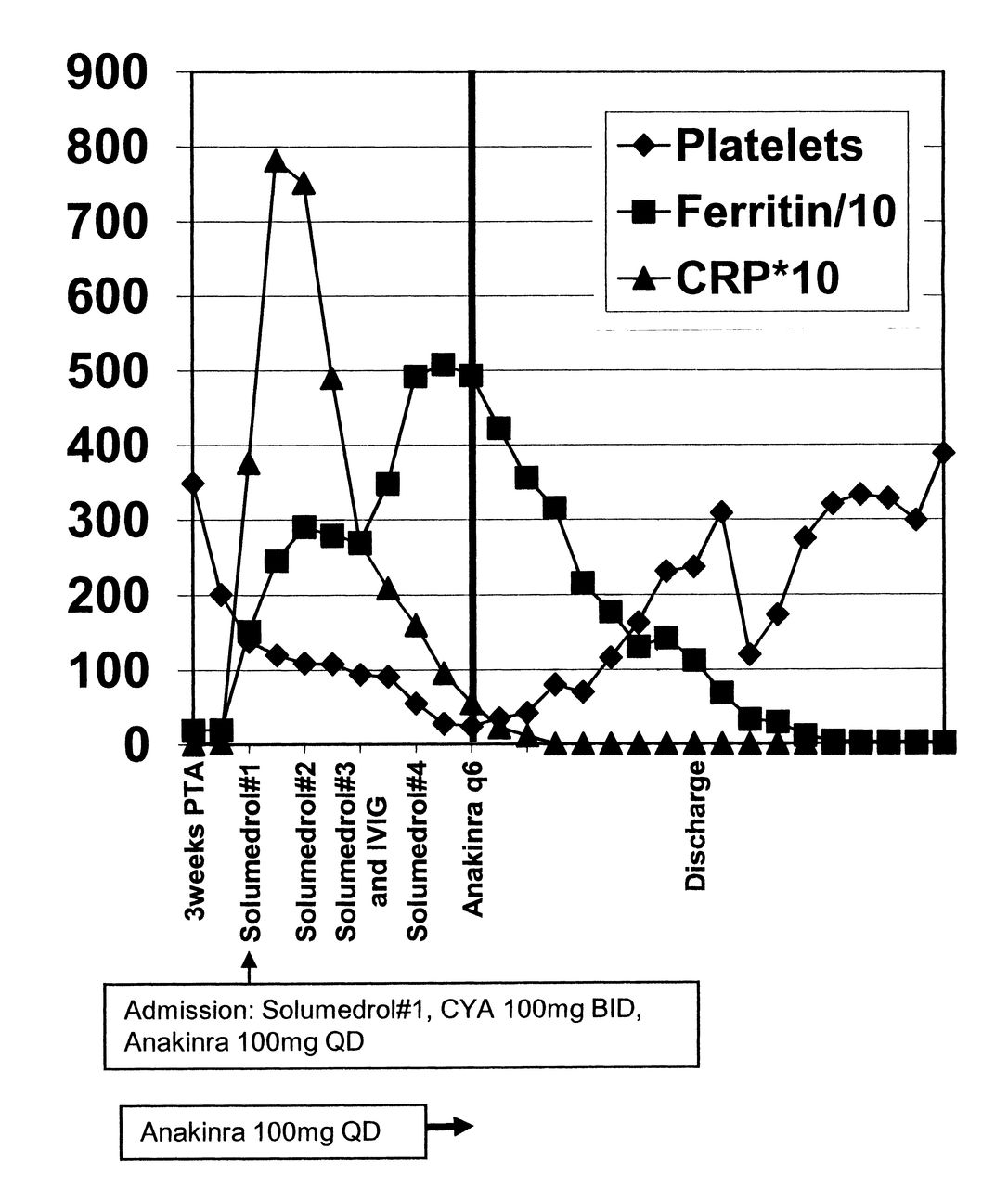
However, because she developed significant medication toxicity (weight gain, hypertension, hirsuitism, and paresthesias), her corticosteroid dose was tapered. She was soon readmitted with anorexia, malaise, and fever. Her medications on admission included prednisone 40 mg daily (0.7 mg/kg), cyclosporine 100 mg twice daily (3.2 mg/kg/day), and anakinra 100 mg daily (1.75 mg/kg). Her laboratory evaluation was significant for the following: ferritin 2456 ng/ml; C-reactive protein (CRP) 78.16 mg/dl; thrombocytopenia 120,000 platelets/mm3; hypertriglyceridemia 338 mg/dl; and erythrocyte sedimentation rate 3 mm/h (Table 1). She was given broad-spectrum antibiotics (blood cultures were eventually negative) and 3 daily pulses of intravenous solumedrol (1000 mg) with rapid defervescence. Nevertheless, the platelet count continued to decline, and her ferritin continued to rise, with worsening hypofibrinogenemia. Cyclosporine was increased to 300 mg daily (4.8 mg/kg, with serum levels in the therapeutic range), and she received 2 additional pulses of solumedrol, and intravenous immunoglobulin (IVIG; 1.5 gm/kg). On the fifth hospitalization day, anakinra was increased to 100 mg every 6 h (6.7 mg/kg/day) because of persistent thrombocytopenia (28,000/mm3); hyperferritinemia (5082 ng/ml); and an acute drop in fibrinogen to 30 mg/dl (Table 1). Every 6 h was chosen as the interval to increase benefit because anakinra has a short half-life (∼4 h) and a high therapeutic window1. Within 24 h, she had complete resolution of her malaise and her laboratory measures significantly improved (Figure 1): platelets 80,000/mm3; ferritin 2156 ng/ml; and fibrinogen 177 mg/dl (Table 1). Six days after high-dose anakinra, she was discharged with no signs of clinical disease activity and the following laboratory values: ferritin 1125 ng/ml; CRP 1.14 mg/dl; platelets 237,000/mm3; triglycerides 524 mg/dl; and fibrinogen 171 mg/dl (Table 1). Discharge medications included prednisone 40 mg twice daily, cyclosporine 300 mg daily, and anakinra 100 mg every 6 h. Prednisone and cyclosporine were tapered over 18 weeks, while she still took anakinra 4 times daily. Anakinra was discontinued 7 months after discharge, and the patient is taking no immunosuppressive therapy 2.5 years after discharge.
Response of macrophage activation syndrome measures to higher-dose anakinra. Platelet count (× 103/mm3), ferritin level (ng/ml divided by 10), and CRP level (mg/dl × 10) are graphed on the Y axis versus time in days (X axis). The vertical bold line represents increasing anakinra from 100 mg daily to 100 mg every 6 h (400 mg/day). Solumedrol (1 g intravenously), intravenous immunoglobulin (IVIG), and cyclosporine (CYA) administrations are noted. Hospital discharge is noted; PTA: prior to admission.
  • Download figure
  • Open in new tab
  • Download powerpoint
Figure 1.

Response of macrophage activation syndrome measures to higher-dose anakinra. Platelet count (× 103/mm3), ferritin level (ng/ml divided by 10), and CRP level (mg/dl × 10) are graphed on the Y axis versus time in days (X axis). The vertical bold line represents increasing anakinra from 100 mg daily to 100 mg every 6 h (400 mg/day). Solumedrol (1 g intravenously), intravenous immunoglobulin (IVIG), and cyclosporine (CYA) administrations are noted. Hospital discharge is noted; PTA: prior to admission.

View this table:
  • View inline
  • View popup
Table 1.

Laboratory data.

This case highlights the importance of aggressive inhibition of IL-1 with anakinra in children with sJIA complicated by refractory MAS. Up to 40% of children with sJIA develop subclinical MAS, including the diagnostic hallmark of hemophagocytosis on bone marrow biopsy2. Another 10% develop overt MAS, prompting aggressive antiinflammatory therapy2. Included among the reactive lymphohistiocytosis syndromes, MAS is a condition of cytokine storm, which may result in nonremitting high fever, encephalopathy, hepatitis, pancytopenia, coagulopathy, and death in up to 22% of patients3. In addition to treatment of ongoing hemodynamic instability, seizure, and bleeding, initiation of immunosuppressive therapy is urgently required for MAS, traditionally including various combinations of high-dose glucocorticoids, cyclosporine, etoposide, thalidomide, antithymocyte globlulin, and IVIG, which carry high risks of infection and other morbidities4.

Disease activity in sJIA is characterized by high levels of IL-1β, a prototypic proinflammatory cytokine5. IL-1 receptor antagonist (IL-1ra) is a naturally occurring IL-1 inhibitor normally produced by macrophages and other cells in response to IL-1, endotoxin, or other infectious pathogens. Anakinra is a recombinant, injectable human IL-1ra with a short half-life (∼4 h) that demonstrated remarkable efficacy in children with refractory sJIA5. Several case reports and series have reported successful use of anakinra in treating patients with MAS who were refractory to medical treatments including glucorticoids, etoposide, cyclosporine, methotrexate, IVIG, etanercept, and infliximab, with significant clinical response within days, including the chance to effectively taper glucocorticoids6,7,8,9,10,11.

In the setting of inflammatory diseases such as sJIA, greater concentrations of the naturally occurring IL-1ra may be required to antagonize the affects of IL-1 abundance, as in neonatal-onset multisystem inflammatory disease, a similar IL-1-mediated autoinflammatory disease in which patients may require doses as high as 10 mg/kg/day, with no apparent increase in infectious complications12. Although theoretic potential toxicities of newer therapeutics such as anakinra may result in appropriate caution, the well-known toxicity of traditional agents such as prednisone, cyclosporine, and etoposide are always concerning and include infection, growth retardation, osteoporosis, nephrotoxicity, neurotoxicity, and even death.

Anakinra, at higher than standard dosing, appears to be a novel, effective, and quick-acting agent. Earlier initiation of anakinra in patients with potentially life-threatening MAS may better treat the underlying mechanisms mediating disease while minimizing toxicity of other more nonspecific agents. One may consider use of higher-dose anakinra in patients with medically refractory MAS. Further prospective study of this approach is warranted.

Footnotes

  • Dr. Cron serves as a consultant to Novartis regarding canakinumab and to Genentech regarding tocilizumab therapy for systemic juvenile idiopathic arthritis.

REFERENCES

  1. 1.↵
    1. Fisher CJ Jr.,
    2. Dhainaut JF,
    3. Opal SM,
    4. Pribble JP,
    5. Balk RA,
    6. Slotman GJ,
    7. et al.
    Recombinant human interleukin 1 receptor antagonist in the treatment of patients with sepsis syndrome. Results from a randomized, double-blind, placebo-controlled trial. Phase III rhIL-1ra Sepsis Syndrome Study Group. JAMA 1994;271:1836–43.
    OpenUrlCrossRefPubMed
  2. 2.↵
    1. Behrens EM,
    2. Beukelman T,
    3. Paessler M,
    4. Cron RQ
    . Occult macrophage activation syndrome in patients with systemic juvenile idiopathic arthritis. J Rheumatol 2007;34:1133–8.
    OpenUrlAbstract/FREE Full Text
  3. 3.↵
    1. Sawhney S,
    2. Woo P,
    3. Murray KJ
    . Macrophage activation syndrome: A potentially fatal complication of rheumatic disorders. Arch Dis Child 2001;85:421–6.
    OpenUrlAbstract/FREE Full Text
  4. 4.↵
    1. Kelly A,
    2. Ramanan AV
    . Recognition and management of macrophage activation syndrome in juvenile arthritis. Curr Opin Rheumatol 2007;19:477–81.
    OpenUrlCrossRefPubMed
  5. 5.↵
    1. Pascual V,
    2. Allantaz F,
    3. Arce E,
    4. Punaro M,
    5. Banchereau J
    . Role of interleukin-1 (IL-1) in the pathogenesis of systemic onset juvenile idiopathic arthritis and clinical response to IL-1 blockade. J Exp Med 2005;201:1479–86.
    OpenUrlAbstract/FREE Full Text
  6. 6.↵
    1. Bruck N,
    2. Suttorp M,
    3. Kabus M,
    4. Heubner G,
    5. Gahr M,
    6. Pessler F
    . Rapid and sustained remission of systemic juvenile idiopathic arthritis-associated macrophage activation syndrome through treatment with anakinra and corticosteroids. J Clin Rheumatol 2011;17:23–7.
    OpenUrlCrossRefPubMed
  7. 7.↵
    1. Kelly A,
    2. Ramanan AV
    . A case of macrophage activation syndrome successfully treated with anakinra. Nat Clin Pract Rheumatol 2008;4:615–20.
    OpenUrlCrossRefPubMed
  8. 8.↵
    1. Miettunen PM,
    2. Narendran A,
    3. Jayanthan A,
    4. Behrens EM,
    5. Cron RQ
    . Successful treatment of severe paediatric rheumatic disease-associated macrophage activation syndrome with interleukin-1 inhibition following conventional immunosuppressive therapy: Case series with 12 patients. Rheumatology 2011;50:417–9.
    OpenUrlFREE Full Text
  9. 9.↵
    1. Ravelli A,
    2. Grom AA,
    3. Behrens EM,
    4. Cron RQ
    . Macrophage activation syndrome as part of systemic juvenile idiopathic arthritis: Diagnosis, genetics, pathophysiology and treatment. Genes Immun 2012;13:289–98.
    OpenUrlCrossRefPubMed
  10. 10.↵
    1. Record JL,
    2. Beukelman T,
    3. Cron RQ
    . Combination therapy of abatacept and anakinra in children with refractory systemic juvenile idiopathic arthritis: A retrospective case series. J Rheumatol 2011;38:180–1.
    OpenUrlFREE Full Text
  11. 11.↵
    1. Verbsky JW,
    2. White AJ
    . Effective use of the recombinant interleukin 1 receptor antagonist anakinra in therapy resistant systemic onset juvenile rheumatoid arthritis. J Rheumatol 2004;31:2071–5.
    OpenUrlAbstract/FREE Full Text
  12. 12.↵
    1. Neven B,
    2. Marvillet I,
    3. Terrada C,
    4. Ferster A,
    5. Boddaert N,
    6. Couloignier V,
    7. et al.
    Long-term efficacy of the interleukin-1 receptor antagonist anakinra in ten patients with neonatal-onset multisystem inflammatory disease/chronic infantile neurologic, cutaneous, articular syndrome. Arthritis Rheum 2010;62:258–67.
    OpenUrlCrossRefPubMed
PreviousNext
Back to top

In this issue

The Journal of Rheumatology
Vol. 40, Issue 5
1 May 2013
  • Table of Contents
  • Table of Contents (PDF)
  • Index by Author
  • Editorial Board (PDF)
Print
Download PDF
Article Alerts
Sign In to Email Alerts with your Email Address
Email Article

Thank you for your interest in spreading the word about The Journal of Rheumatology.

NOTE: We only request your email address so that the person you are recommending the page to knows that you wanted them to see it, and that it is not junk mail. We do not capture any email address.

Enter multiple addresses on separate lines or separate them with commas.
Higher-dose Anakinra Is Effective in a Case of Medically Refractory Macrophage Activation Syndrome
(Your Name) has forwarded a page to you from The Journal of Rheumatology
(Your Name) thought you would like to see this page from the The Journal of Rheumatology web site.
CAPTCHA
This question is for testing whether or not you are a human visitor and to prevent automated spam submissions.
Citation Tools
Higher-dose Anakinra Is Effective in a Case of Medically Refractory Macrophage Activation Syndrome
PHILIP J. KAHN, RANDY Q. CRON
The Journal of Rheumatology May 2013, 40 (5) 743-744; DOI: 10.3899/jrheum.121098

Citation Manager Formats

  • BibTeX
  • Bookends
  • EasyBib
  • EndNote (tagged)
  • EndNote 8 (xml)
  • Medlars
  • Mendeley
  • Papers
  • RefWorks Tagged
  • Ref Manager
  • RIS
  • Zotero

 Request Permissions

Share
Higher-dose Anakinra Is Effective in a Case of Medically Refractory Macrophage Activation Syndrome
PHILIP J. KAHN, RANDY Q. CRON
The Journal of Rheumatology May 2013, 40 (5) 743-744; DOI: 10.3899/jrheum.121098
del.icio.us logo Twitter logo Facebook logo  logo Mendeley logo
  • Tweet Widget
  •  logo
Bookmark this article

Jump to section

  • Article
    • Footnotes
    • REFERENCES
  • Figures & Data
  • Info & Metrics
  • References
  • PDF

Related Articles

Cited By...

More in this TOC Section

  • Early-Onset Calcium Pyrophosphate Disease Associated With Genetic Hypomagnesemia: Beyond Gitelman Syndrome
  • Juvenile Arthritis Quality of Life Questionnaire Responder Metrics in Juvenile Idiopathic Arthritis: Clarifying Health-Related Quality of Life Changes Across Treatment Eras
  • Dr. Tsai et al reply
Show more Letter

Similar Articles

Content

  • First Release
  • Current
  • Archives
  • Collections
  • Audiovisual Rheum
  • COVID-19 and Rheumatology

Resources

  • Guide for Authors
  • Submit Manuscript
  • Author Payment
  • Reviewers
  • Advertisers
  • Classified Ads
  • Reprints and Translations
  • Permissions
  • Meetings
  • FAQ
  • Policies

Subscribers

  • Subscription Information
  • Purchase Subscription
  • Your Account
  • Terms and Conditions

More

  • About Us
  • Contact Us
  • My Alerts
  • My Folders
  • Privacy/GDPR Policy
  • RSS Feeds
The Journal of Rheumatology
The content of this site is intended for health care professionals.
Copyright © 2025 by The Journal of Rheumatology Publishing Co. Ltd.
Print ISSN: 0315-162X; Online ISSN: 1499-2752
Powered by HighWire