Abstract
Objective. Digital ulcers are the most frequent vascular manifestations of systemic sclerosis (SSc). Clinical features of patients with prior or current digital ulcers have not been extensively described. This cross-sectional analysis of a large multicenter cohort compared the characteristics of SSc patients with prior or current digital ulcers with those never affected.
Methods. Patients with prior/current digital ulcers or never affected were identified in the cohort of SSc patients enrolled in the French ItinérAIR-Sclérodermie registry. Rodnan skin scores, pulmonary function test results, and clinical and immunological data were analyzed to identify digital ulcerassociated clinical features.
Results. Of 599 SSc patients, 317 had prior or current digital ulcers. These patients were more frequently male, with impaired diffusing capacity for carbon monoxide (DLCO), and higher Rodnan skin scores than patients never affected by digital ulcers. In a multivariate analysis, male gender, early onset of SSc, increased duration of SSc, high Rodnan skin score, and presence of anti-topoisomerase I antibodies (anti-topo I) were associated with prior or current digital ulcers. Comparison of patients with current digital ulcers versus patients never affected indicated that affected patients had increased duration of SSc, impaired DLCO, increased Rodnan score, and younger age at onset of SSc.
Conclusion. Male patients with early onset SSc, more severe skin fibrosis, impaired DLCO, and anti-topo I were most likely to exhibit prior or current digital ulcers. Confirmation of these results in a prospective longitudinal study may enable identification of patients at greatest risk of developing digital ulcers, facilitating management of this disabling complication.
Systemic sclerosis (SSc) is a chronic autoimmune connective tissue disease with unknown etiology and poor prognosis. SSc is characterized by widespread vasculopathy and excessive fibrosis in the skin and viscera. The vascular dysfunction that characterizes SSc includes vascular remodeling with severe capillary loss and progressive narrowing of the lumen of small arteries. This remodeling is associated with Raynaud’s phenomenon (RP), skin ischemia, and necrosis1–3.
Patients with SSc and persistent digital ischemia may also develop digital ulcers. The pathophysiology of ischemic digital ulcers is complex and incompletely understood. It includes endothelial damage and imbalance of vasomotor tone; dysregulation in angiogenic homeostasis; and inflammation, all of which contribute to the development and the severity of digital ulcers4.
Digital vasculopathy is a serious complication of SSc, contributing significant morbidity and often requiring hospital-based management5. A history of ischemic digital ulcers is reported by 30%–50% of SSc patients4,6,7. Recurrence of digital ulcer episodes is frequent2–4,8. Digital ulcers can be extremely painful, cause significant functional disability, and severely impair patients’ quality of life8,9. These vascular manifestations heal very slowly and may lead to additional complications such as infection and gangrene2. However, the detailed clinical features of SSc patients who experienced at least one digital ulcer during the course of their disease have not been fully described. In order to facilitate the future identification of high-risk patients, we compared the characteristics of SSc patients with prior or current digital ulcers with those never affected by digital ulcers at the time of their enrolment in a large, multicenter, prospective SSc registry, the “ItinérAIR-Sclérodermie”10.
MATERIALS AND METHODS
Patients
Our study was a post-hoc analysis of the ItinérAIR-Sclérodermie registry, of which the primary aim was to implement a screening program for pulmonary arterial hypertension (PAH) in patients with SSc10. This registry prospectively included all consecutive SSc patients who attended 21 French university hospitals between September 2002 and July 2003. All patients met the American College of Rheumatology (ACR) criteria for SSc at the time of diagnosis11 and were enrolled after providing written informed consent. Patients were classified as having diffuse cutaneous SSc or limited cutaneous SSc according to LeRoy criteria12. This registry was dedicated to PAH screening, hence patients with known severe cardiac disease (left ventricular ejection fraction < 45%) and patients with severe pulmonary function abnormalities [defined as forced vital capacity (FVC), total lung capacity (TLC) or forced expiratory volume in 1 second < 60% of predicted] were excluded. Indeed these patients might be more prone to other types of pulmonary hypertension. Digital ulcers occurring above the interphalangeal and metacarpophalangeal joints can be of either ischemic or mechanical origin; therefore, to analyze specifically digital ulcers of ischemic origin, we collected data only for digital ulcers localized on the fingertips. For the same reason, digital ulcers occurring above calcifications were not reported. Current digital ulcers were defined as ischemic digital ulcers localized on fingertips present at the time of enrolment and noted by investigators. Prior digital ulcers were defined as a history of digital ulcers on the fingertips reported by a patient. Data collected at enrolment in the registry included demographics, tobacco use, occupational exposure to silicate, solvents, glue and resin, SSc history, and immunological status. Skin fibrosis was assessed by the total Rodnan skin score13 including fibrosis distal to the interphalangeal joints. This score, rather than the modified Rodnan skin score, was used to calculate the digital sclerosis score, an index for describing finger skin thickness. Digital sclerosis score was calculated by addition of Rodnan subscores distal to metacarpophalangeal joints (range 0–18). Pulmonary function tests, including single-breath carbon monoxide diffusing capacity (DLCO) were performed at enrolment. Pulmonary function test results were expressed as percentages of predicted values14.
Statistical analysis
Disease duration was calculated from the first non-RP clinical symptom of SSc to the date of enrolment into the registry, and divided into quartiles. The comparison of demographic and clinical characteristics at enrolment between patients with only prior digital ulcers and patients with current digital ulcers did not reveal any relevant differences, except for Rodnan skin score and DLCO (data not shown). These 2 groups of patients were therefore considered as a single group. Comparisons of patients with current digital ulcers and patients never affected by digital ulcers were appropriate given the concurrent measurement of DLCO and Rodnan skin score with the current digital ulcer manifestation at the time of enrolment.
Prevalence estimates of prior or current digital ulcers are presented with 95% 2-sided confidence intervals (95% CI), assuming a binomial distribution. Frequencies and percentages were used to describe categorical data, with mean and standard deviations (mean ± SD) restricted to the description of continuous variables unless otherwise specified. Patients with prior or current digital ulcers were compared with patients never affected by digital ulcers using analysis of variance for continuous variables and chi-squared testing for categorical data. Stratified comparisons of categorical data were conducted by the Cochran-Mantel-Haenszel test. Adjusted comparisons were made using covariance or logistic regression analyses. Multivariate analyses were conducted using a logistic model. Analyses were conducted without formal adjustment of the type I risk error threshold for multiple comparisons. Data were analyzed using SAS 9.1 software (SAS Institute, Cary, NC, USA).
RESULTS
In total, 599 patients were studied, including 165 (28%) with diffuse cutaneous SSc and 434 (72%) with limited cutaneous SSc. Clinical characteristics of patients enrolled in the ItinérAIR-Sclérodermie registry are reported in Table 1.
Clinical characteristics at time of enrolment in the ItinérAIR-Sclérodermie registry according to systemic sclerosis subtype. Categorical data are expressed as percentages, continuous data are mean ± SD.
Patient characteristics according to digital ulcer status
In total, 317 patients had prior or current digital ulcers, a prevalence of 52.9% (95% CI 48.9%, 56.9%). Of these, 243 (40.6%; 95% CI 36.6%, 44.5%) had prior but no current digital ulcers at the time of enrolment, and 74 (12.4%; 95% CI 9.7%, 15.0%) had current digital ulcers at study entry. All patients with current digital ulcers had experienced at least one previous episode. Patient characteristics according to digital ulcer status are reported in Table 2. Digital ulcers were more frequent in patients with diffuse cutaneous SSc than in patients with limited cutaneous SSc (60.6% vs 50.0%, respectively; p = 0.02). Results were similar after splitting the population into 2 groups by the median duration of SSc (Cochran-Mantel-Haenszel test p = 0.02). At enrolment, 16% of patients with diffuse cutaneous versus 11% of patients with limited cutaneous SSc presented with current digital ulcers (p = 0.12; Figure 1).

Prevalence of prior and current digital ulcers. DU: digital ulcers; SSc: systemic sclerosis.
Characteristics of patients with systemic sclerosis according to digital ulcer status. Categorical data are expressed as percentages; continuous data are mean ± SD.
The proportion of males was significantly higher in the group with prior or current digital ulcers (p = 0.0005). Patients in this group, compared with patients never affected by digital ulcers, were younger at onset of SSc, had longer disease duration, and exhibited a greater extent of skin fibrosis regardless of SSc subtype (Table 2). Anti-topo I occurred more frequently in patients with prior or current digital ulcers, whereas anticentromere antibodies (ACA) were more common in patients never affected by digital ulcers.
In the subset of patients with prior or current digital ulcers, the percentage of patients who had never smoked was lower, and the occupational exposure more frequent, in comparison with patients never affected by digital ulcers. These differences were, however, not confirmed when comparisons were adjusted for gender. No differences in TLC and FVC were observed between the 2 groups, although a greater proportion of patients with prior or current digital ulcers exhibited DLCO < 60% predicted. Similar numbers of patients in each subgroup exhibited PAH.
Characteristics of patients with current digital ulcers
The characteristics of patients with current digital ulcers were also investigated (data not shown). Comparisons with patients never affected by digital ulcers gave results consistent with the previous analysis, emphasizing the role of DLCO and Rodnan skin score. Indeed, a greater proportion of patients with current digital ulcers exhibited DLCO < 60% predicted than did patients never affected by digital ulcers (43% vs 20%; p < 0.0001). No differences were found in other pulmonary function tests (TLC, FVC), and results remained unchanged when comparisons were restricted to patients without PAH and/or FVC < 80%. Extent of skin fibrosis, assessed by Rodnan skin score and digital sclerosis score, was more important in patients with current digital ulcers, regardless of SSc subtype.
Multivariate analysis of digital ulcer determinants
Two multivariate models were created to analyze clinical features associated with prior or current digital ulcers. Sex, age, SSc subtype, SSc duration, age at first SSc symptom, Rodnan skin score, smoking status, and DLCO < 60% of predicted were introduced in both models. Using the first model, male sex, early occurrence of SSc, and high Rodnan skin score were associated with prior or current digital ulcers (Table 3). In this multiadjusted model, neither SSc subtype nor tobacco consumption was identified as a significant determinant. Using the second model, male sex, high Rodnan skin score, and DLCO < 60% predicted were associated with current digital ulcers (Table 4).
Factors associated with prior or current digital ulcers in a multivariate model. The association of predicted probabilities and observed responses (c criterion) for this model was 0.691.
Factors associated with current digital ulcers in a multivariate model. The association of predicted probabilities and observed responses (c criterion) for this model was 0.801.
Relationship between Rodnan skin score and digital ulcers
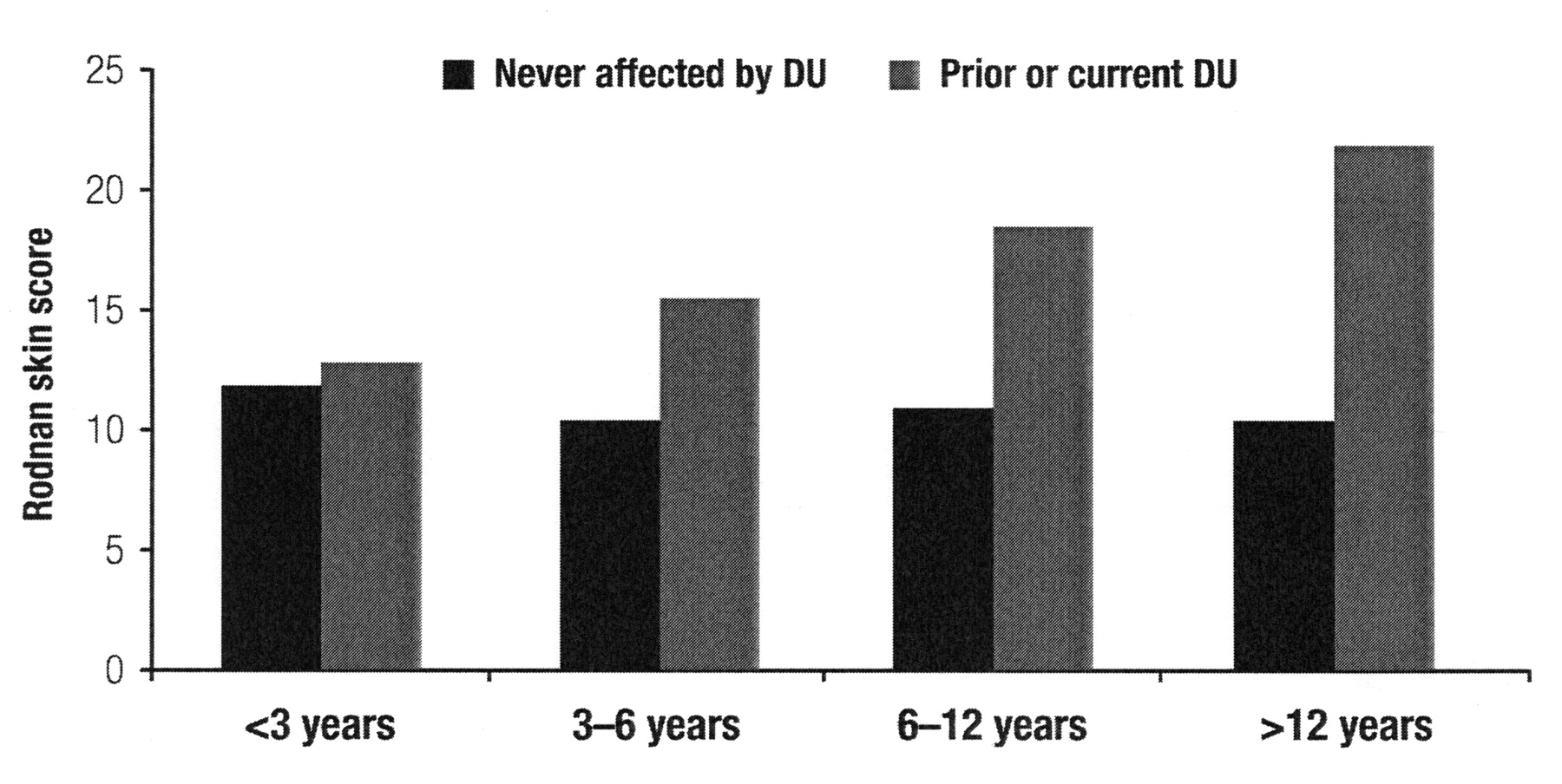
In order to facilitate the investigation of a relationship between skin fibrosis and the history or presence of digital ulcers, the population was divided into quartiles according to disease duration. In patients with prior or current digital ulcers, more extensive skin fibrosis (with higher Rodnan skin score and digital sclerosis score) was observed with longer disease duration. In patients never affected by digital ulcers, skin involvement did not exacerbate with increasing disease duration (Figure 2). No difference in Rodnan skin score was observed between patients with prior or current digital ulcers and those never affected by digital ulcers during early-stage SSc.

Rodnan skin score according to disease duration. DU: digital ulcers
DISCUSSION
This multicenter, cross-sectional analysis of 599 patients with SSc found that 53% had prior or current digital ulcers. Digital ulcers occurred more frequently among males, patients with a higher Rodnan skin score, patients with early onset of disease, patients with DLCO < 60% predicted, and patients with anti-topo I antibodies. Smoking status and exposure to occupational hazards were not significantly associated with the occurrence of digital ulcers when comparisons were adjusted for gender. The frequency of PAH was no higher in patients with prior or current digital ulcers than in those never affected. In addition, we observed that in patients with prior or current digital ulcers, longer durations of SSc were associated with a greater extent of skin fibrosis; an association that strengthened with increasing time.
The prevalence of prior and current digital ulcers observed in this study was consistent with that reported in previous studies (25%–48%)2–4,6,8,10. As in most other series, patients in this multicenter registry were seen in tertiary referral centers for SSc management and, consequently, probably had more severe disease. This could result in an overestimation of digital ulcer prevalence.
A few studies have comprehensively described clinical features associated with the occurrence of digital ulcers5,15. In our study, a greater proportion of patients with diffuse cutaneous SSc than limited cutaneous SSc exhibited prior or current digital ulcers. These data are consistent with those from other recent studies3,5,16,17. The higher prevalence of anti-topo I in patients with prior or current digital ulcers has been reported7, and was explained by the association between digital ulcers and diffuse cutaneous SSc subtype. Consistent with the recent report by Nihtyanova, et al5, we found that anti-topo I were more frequent in patients with digital ulcers, both for diffuse and limited SSc. ACA were found more frequently in patients with limited cutaneous SSc never affected by digital ulcers, whereas there was no difference in patients with diffuse cutaneous SSc. These results are different from those published by Wigley, et al18, who found that ACA were predictors of digital ischemic loss. In patients with less severe disease, Steen, et al reported a relationship between ACA and digital ulcers7. The same authors, in a larger cohort, reported a similar prevalence of digital ulcers in patients with ACA and in patients with anti-topo I, suggesting a more severe peripheral vascular disease related to specific autoantibodies17.
We found no relationship between the experience of at least one digital ulcer during the course of SSc and smoking habits after adjustment for gender. Tobacco use is recognized to aggravate the course of digital ulcers and to increase the likelihood of more severe outcomes such as gangrene and digital amputations19. No data on digital ulcer severity (recurrence frequency or outcomes) were collected in our study. It remains possible that tobacco does not promote digital ulcers but aggravates outcomes.
Endothelial damage and fibrosis are understood to be of considerable importance to the pathogenesis of digital ulcers9. We stratified our population by duration of SSc. In patients with recent-onset SSc, a similar extent of skin fibrosis was found in patients with prior or current digital ulcers and in patients never affected. Conversely, in patients with long-standing SSc, extent of skin fibrosis was greater in patients with prior or current digital ulcers than in patients never affected. Moreover, comparing the extent of skin fibrosis between recent-onset and long-standing SSc according to digital ulcer status, it was found that fibrosis was more extensive in patients with long-standing SSc, exclusively if the patient reported a prior or current digital ulcer. Clearly, digital ulcer history is associated with a distinct pattern of skin fibrosis progression in patients with SSc. This finding may also suggest that fibrosis is not primarily involved in the development of digital ulcers in recent-onset SSc. These data should be interpreted cautiously because of the well known interobserver variability of the Rodnan skin score and the spontaneous decrease in score during the course of SSc13,20,21.
DLCO measures dynamic gas exchanges through the alveolar membrane and can be influenced by the thickness of the alveolar membrane and lung capillary volume22,23. A reduced DLCO in the absence of impairment in pulmonary function may represent a surrogate marker of vasculopathy24–26. In our patients, the results of multivariate analyses suggest that DLCO impairment was strongly associated with current digital ulcers, independent of disease duration. The relationship between decreased DLCO and digital ulcers also persisted when patients with PAH, pulmonary fibrosis, or impaired pulmonary function test results were excluded from this analysis. The association of DLCO impairment and current digital ulcers may be the sign of the pathophysiological link between vasculopathy and digital ulcers. Steen, et al25 reported that patients who develop PAH had severe decreases in DLCO (< 52%), more severe peripheral vascular disease, and limited cutaneous SSc, emphasizing the potential relation between digital ulcers and PAH. However, like other authors17, we found no relationship between prior or current digital ulcers and PAH. We hypothesize that vasculopathy may be mainly expressed in digital arteries in some patients and pulmonary arteries in others. Further studies are needed to assess whether patients with digital ulcers constitute a subgroup of patients at higher risk of subsequently developing PAH.
While this study identifies a number of clinical features associated with prior or current digital ulcers, it has some limitations. The main one is that the study is a post-hoc analysis of a registry conducted for another purpose, namely, to evaluate the prevalence of PAH in SSc patients. As a consequence, details relevant to our present study, such as number of digital ulcers, topography, and time of occurrence of first digital ulcer, were not collected. Some potential risk factors or confounders may have been missed in the analysis, thereby limiting interpretation. To be enrolled, patients had to meet ACR criteria for diagnosis of SSc. It is well known that a small proportion of SSc patients do not meet these criteria at the beginning of the disease (e.g., patients with scleroderma sine scleroderma); therefore such patients may not have been enrolled in this study. Analysis was limited to the fingertips to make sure that digital ulcers were of ischemic origin, but we cannot exclude that some genuine ischemic digital ulcers situated in other finger areas were missed.
Patients with severe interstitial lung disease were not enrolled in the study, allowing a relevant analysis of the potential role of DLCO to be conducted. Digital ulcer prevalence may be greater in these patients. In Medsger’s disease severity scale, a parallel was drawn between the greater severity of the peripheral vascular disease and interstitial lung fibrosis27. Similarly, exclusion of patients with left heart disease could be a source of bias. A further potential source of bias is the inclusion of patients from referral centers only, since referred patients may exhibit a different frequency or severity of digital ulcer episodes than those in the total SSc population. Caution should be exercised in extending our results to the whole SSc population. Finally, this was a cross-sectional analysis of a prospective cohort and we cannot conclude that clinical features associated with prior or current digital ulcers are real risk factors. However, this attempt to describe the clinical profile of patients with prior or current digital ulcers in such a large sample of SSc patients could guide future research. The prospective followup of the ItinérAIR-Sclérodermie cohort over 3 years will be of great interest to qualify associated clinical features as risk factors.
In conclusion, digital ulcers in patients with SSc represent a frequent and recurrent complication that is associated with high morbidity and important functional disability. Our study identified several clinical features associated with prior or current digital ulcers including male gender, high Rodnan skin score, impaired DLCO, young age at time of SSc onset, and presence of anti-topo I. In order to optimize therapeutic management, screening of patients at greatest risk of digital ulcers should be considered, combined with close followup and preventive measures. Further studies, especially the 3-year followup of the ItinérAIR-Sclérodermie cohort, will be required to qualify these associated clinical features as risk factors.
Acknowledgments
ItinérAIR-Sclerodermie Investigators Group: Loïc Guillevin, Jean-Marie Houeix, Luc Mouthon, Linda Nasciembeni (Bobigny, Avicenne); Virginie Bernard, Marc-Alain Billès, Marie-Sylvie Doutre, Claire Dromer, Stéphane Lafitte, Thierry Schaeverbeke, Jean-François Viallard (Bordeaux 1); Joël Constans, Philippe Gosse, Philippe Lemetayer (Bordeaux 2); Abdul Monem Hamid, Marc Humbert, Vincent Ioos, Xavier Jaïs, Gérald Simonneau, Olivier Sitbon (Clamart, Antoine Béclère); Serge Adnot, Anne Cosnes, Pascal Guéret, Juliette Rousseau (Créteil, Henri-Mondor); Patrick Carpentier, Jean-Louis Cracowski, Christophe Pison (Grenoble); Joël Dagorn, Pascal de Groote, Eric Hachulla, Pierre-Yves Hatron, Marc Lambert, Nicolas Lamblin, David Launay, Viviane Queyrel (Lille); Jean-Yves Bayle, Michèle Bertocchi, Jean-François Cordier, Fadi Jamal, Jacques Ninet, Michel Ovize (Lyon); Sylvie Hesse-Bonerandi, Martine Reynaud-Gaubert, Gilbert Habib, Jean-Robert Harle, Sébastien Renard, Frédérique Retornaz (Marseille); François Chabot, Claude Schmidt, Jean-Luc Schmutz, Christine Suty-Selton, (Nancy); Christian Agard, Erwan Bressolette, Alain Haloun, Mohamed Hamidou, Jean-Marc Langlard (Nantes); Eric Brochet, Olivier Lidove, Thomas Papo, Catherine Picard-Dahan, Dominique de Zuttere (Paris, Bichat); Yannick Allanore, Laure Cabanes, André Kahan, Christophe Meune, Christian Spaulding (Paris, Cochin); Camille Francès, Anne-Claude Koeger, Dominique de Zuttere (Paris, La Pitié-Salpêtrière); Jean Cabane, Ariel Cohen, Kiet Phong Tiev (Paris Saint-Antoine); Yara Antakly-Hanon, Isabelle Lazareth, Ulrique Michon-Pasturel (Paris, Saint-Joseph); Dominique Farge, Suzanne Ménasché (Paris, Saint-Louis); Jacqueline Chevrant-Breton, Philippe Delaval, Patrice Jego, Marcel Laurent (Rennes); Fabrice Bauer, Geneviève Dérumeaux, Hélène Etchaninoff, Isabelle Marie (Rouen); Ari Chaouat, Jean-Louis Pasquali, Hélène Petit, Jean Sibilia (Strasbourg); Daniel Adoue, Daniel Conte, Bruno Degano (Toulouse); Véronique Eder, Elisabeth Diot, Christian Marchal, Laurent Machet, Olivier Marie, Frédéric Patat (Tours, France).
Footnotes
-
Supported by a research grant from Actelion Pharmaceuticals France. The study sponsor provided editorial assistance during the preparation of the manuscript. Eric Hachulla has received support from Actelion Pharmaceuticals AG, GSK, and Pfizer for speaking engagements or consultancy; and a research grant from Actelion Pharmaceuticals AG. Patrick Carpentier has received honoraria for lectures, symposia, and advisory boards sponsored by Actelion Pharmaceuticals France. Dominique Farge-Bancel has received funds for research from Actelion. Frédérique Dupuis-Siméon is an employee of Actelion.
- Accepted for publication February 12, 2009.